Cumberland (England) -- Fiction; Domestic fiction; Inheritance and succession -- Fiction; Mothers and daughters -- Fiction
"True; they have both been warm friends; and if ever I forget them
may God forget me. I trust that we may both live to show them that
they are not forgotten. But it is not fitting that there should exist
between you and him the intimacy of equal positions. You are not and
cannot be his equal. He has been born to be a tailor, and you are the
daughter and heiress of an Earl."
These last words were spoken in a tone that was almost awful to
the Lady Anna. She had heard so much of her father's rank and her
father's wealth,--rank and wealth which were always to be hers,
but which had never as yet reached her, which had been a perpetual
trouble to her, and a crushing weight upon her young life, that she
had almost learned to hate the title and the claim. Of course it was
a part of the religion of her life that her mother had been duly
married to her father. It was beyond a doubt to her that such was the
case. But the constant battling for denied rights, the assumption of
a position which could not be attained, the use of titles which were
simply ridiculous in themselves as connected with the kind of life
which she was obliged to lead,--these things had all become odious
to her. She lacked the ambition which gave her mother strength, and
would gladly have become Anna Murray or Anna Lovel, with a girl's
ordinary privilege of loving her lover, had such an easy life been
possible to her.
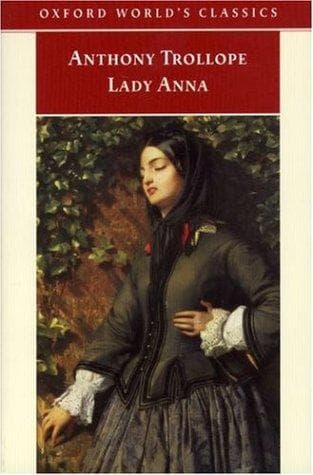
In person she was very lovely, less tall and robust than her mother
had been, but with a sweeter, softer face. Her hair was less dark,
and her eyes were neither blue nor bold. But they were bright and
soft and very eloquent, and when laden with tears would have softened
the heart,--almost of her father. She was as yet less powerful than
her mother, both in body and mind, but probably better calculated to
make a happy home for a husband and children. She was affectionate,
self-denying, and feminine. Had that offer of compromise for thirty,
twenty, or for ten thousand pounds been made to her, she would have
accepted it willingly,--caring little for her name, little even for
fame, so that she might have been happy and quiet, and at liberty to
think of a lover as are other girls. In her present condition, how
could she have any happy love? She was the Lady Anna Lovel, heir to
a ducal fortune,--but she lived in small close lodgings in Wyndham
Street, New Road. She did not believe in the good time coming as did
her mother. Their enemy was an undoubted Earl, undoubtedly owner of
Lovel Grange of which she had heard all her life. Would it not be
better to take what the young lord chose to give them and to be at
rest? But she did not dare to express such thoughts to her mother.
Her mother would have crushed her with a look.
"I have told Mr. Thwaite," the mother said to her daughter, "what we
were saying this morning."
"About his son?"
"Yes,--about his son."
"Oh, mamma!"
"I was bound to do so."
"And what did he say, mamma?"
Public-domain text, read in full here on John Shaqi.
Reviews
Reviews
No reviews yet
Be the first to share your thoughts on this work.
Join the Discussion
Join the discussion
Sign in to leave a comment or review.
Sign InorCreate an account