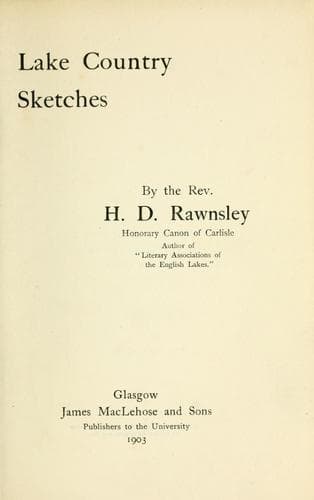
Lake country sketchesRawnsley, H. D. (Hardwicke Drummond)
General
Lake country sketches
Rawnsley, H. D. (Hardwicke Drummond)
Lake District (England); Wordsworth, William, 1770-1850 -- Homes and haunts -- England -- Lake District
I pass over sundry interviews of minor import, and will detail as
accurately as I can the result of several conversations with one who
as a boy lived as page, or butler's assistant, at Rydal Mount, and
now himself in total eclipse (for he is blind) delights to handle and
show with pride the massy, old-fashioned square glazed hand-lantern,
that lighted his master the poet on his favourite evening walks.
We go through Ambleside to reach his house, and call for a moment at
the shop of a man for whom on his wedding-day Hartley Coleridge wrote
the touching sonnet in which he describes himself as
Untimely old, irreverendly grey,
and he will tell us that Mr. Wordsworth was not a man of very
outgoing ways with folk, a plain man, a very austere man, and one who
was ponderous in his speech. That he called very often at his shop,
and would talk, 'but not about much,' just passing the day. He will
tell us that Mrs. Wordsworth was a very plain-faced lady, but will
add that, 'for {45} aw that, Mr. Wordsworth and she were very fond of
one another.'
There is, as one would expect, a sort of general feeling among the
dalesmen that it was rather a strange thing that two people so
austere and uncomely in mere line of feature or figure should be so
much in love, and so gentle and considerate in their lives. I say as
we should expect, for the men of Lakeland and the women of Lakeland
are notably comely, their features notably regular. I do not myself
know of a single instance of a really ugly married woman among the
peasants that I have met with in Westmoreland. But at the same time
we must remember that the word 'plain,' whether applied to dress or
feature, in Westmoreland, means for the most part simple, homely,
unpretending, unassuming, and is often a term of honour rather than
dispraise.
We shall, perhaps, as we near the village where our blind friend
lives, meet with an old man who will tell us that he helped to bear
both the poet and his wife to the grave, but he will add that he was
not 'over weel acquent wi' 'em, though he knas the room they both
died in,' and that the time he saw most of the poet was the occasion
{46} when he conducted Queen Adelaide 'to see the Rydal Falls, and
all about.'
Public-domain text, read in full here on John Shaqi.
Reviews
Reviews
No reviews yet
Be the first to share your thoughts on this work.
Join the Discussion
Join the discussion
Sign in to leave a comment or review.
Sign InorCreate an account