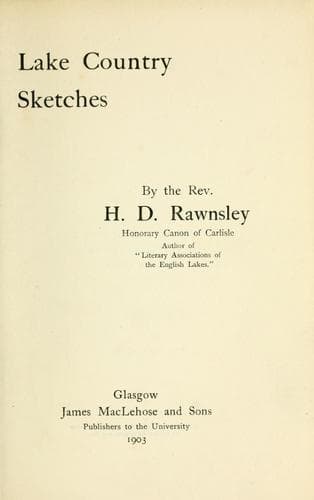
Lake country sketchesRawnsley, H. D. (Hardwicke Drummond)
General
Lake country sketches
Rawnsley, H. D. (Hardwicke Drummond)
Lake District (England); Wordsworth, William, 1770-1850 -- Homes and haunts -- England -- Lake District
We approached, and walking with care found the ground cup-marked with
little baskets or basket-bottoms roughly woven of tussock grass or
sea-bent. Each casket contained from two to three magnificent
jewels. These were the eggs we had come so far to see. There they
lay--deep brown blotched with purple, light bronze marked with brown,
pale green dashed with umber, white shading into blue. All colours
and all sizes; some as small as a pigeon's, others as large as a
bantam's. Three seemed to be the general complement. In one nest I
found four. The nests were so close to one another that I counted
twenty-six within a radius of ten yards; and what struck one most was
the way in which, instead of seeking shelter, the birds had evidently
planned to nest on every bit of rising ground from which swift
outlook over the gull-nursery could be obtained.
Who shall describe the uproar and anger with which one was greeted as
one stood in the midst of the nests? The black-headed gull swept at
one with open beak, and one found oneself involuntarily shading one's
face and protecting one's eyes as the savage little sooty-brown heads
swooped round one's head. But {63} we were not the only foes they
had had to battle with. The carrion crow had evidently been an
intruder and a thief; and many an egg which was beginning to be hard
set on, had been prey to the black robber's beak. One was being
robbed as I stood there in the midst of the hubbub.
Away, for what seemed the best part of a mile, the 'gullery'
stretched to the north in the direction of Seascale; and one felt
that, thanks to the public-spirited owner of the seaboard, and the
County Council of Cumberland, the black-headed gull was not likely to
diminish in this generation.
Back to the boat we went with a feeling that we owed large apologies
to the whole sea-gull race for giving this colony such alarm, and
causing such apparent disquietude of heart, and large thanks to the
lord of Muncaster for his ceaseless care of the wild sea-people whom
each year he entertains upon his golden dunes.
That evening I went back in memory to the marvellous sight in the
Gullery at Ravenglass. My thoughts took sonnet form as follows:
THE HOPE OF LIFE.
Sudden the lilies of each lonely mound
Sprang into voice and palpitating wing;
I seemed a guilty and unwelcome thing;
{64}
Ten thousand shadows round me and around
Perplexed the air and danced along the ground;
Each sooty head, in passion, dared to fling
A world's defiance--and I felt the sting
And arrows of that deprecating sound.
Then gazing downward at my feet I saw
The silent cause of all these sorrowful cries,
--Large jewels, blotched and brown and green and blue,
In simple caskets wove from rushy straw;
I thanked high Heaven for hearts so good and true,
And shared their hope for life that never dies.
Public-domain text, read in full here on John Shaqi.
Reviews
Reviews
No reviews yet
Be the first to share your thoughts on this work.
Join the Discussion
Join the discussion
Sign in to leave a comment or review.
Sign InorCreate an account