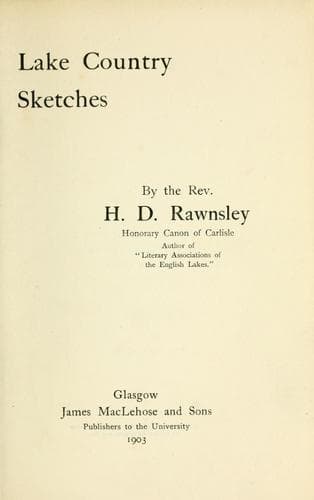
Lake country sketchesRawnsley, H. D. (Hardwicke Drummond)
General
Lake country sketches
Rawnsley, H. D. (Hardwicke Drummond)
Lake District (England); Wordsworth, William, 1770-1850 -- Homes and haunts -- England -- Lake District
One's walks and talks with the few who remember Wordsworth, or
_Wudsworth_ as they always call him, have done little to find out
more than the impression that they as outsiders formed of him, but it
allowed one to grasp by the hand a few of those natural noblemen who
by their presence still give testimony to a time and a race of men
and women fast fading away, and in need already of the immortality of
lofty tradition that Wordsworth has accorded them.
While these few of his still living peasant contemporaries show us
the sort of atmosphere of severely simple life, hand-in-hand with a
'joy in wildest commonalty spread,' that made some of Wordsworth's
poems possible, I think the facts that they seem to establish of
Wordsworth's seclusion, and the distance he seems to have kept from
them and their cottage homes, not a little interesting. For they
point to the suggestion that the poet lived so separate and apart
from them, so seldom entered the 'huts where poor men lie,' or mixed
with the fell-side folk at their sports and junketings, that he was
enabled, in his swift selection and appreciation of the good and pure
and true in their surroundings, to forget, quite honestly perhaps,
{5} the faults of the people among whom he lived.
Be that as it may, this paper aims at establishing no new doctrine or
view about the man, but at simply putting on record reminiscences
still in the minds of some of those who often saw him, knew his
fancies and his ways (as only servants know the fancies and ways of
their master), and spoke with him sixty, fifty, or forty years ago.[1]
[1] This paper was written in 1881 and was read at the annual meeting
of the Wordsworth Society in London in 1882--Robert Browning in the
chair.
These reminiscences may seem worthless to many, just from the fact
that they are the words of outsiders. They will seem to others of
interest for that very reason. And this much must be said, they are
trustworthy records from true mouths. The native _love of truth_, or
perhaps better, the native _dislike ever to hazard suggestion_, or to
speak _without book_, is guarantee for that. To ask questions in
Westmoreland is the reverse of asking them of Syrian fellaheen and
Egyptian dragomans. The Cumberland mind is not inventive, nor swift
to anticipate the answer you wish, and one is always brought up sharp
with--
'Nay, I wadnt say that nayther':
{6}
'Nay, I'se not sartain aboot that':
'Might bea, but not to my knowledge howivver:
'Its nea good my saaing I kna that, when I doant, noo than,'--and so
on.
Public-domain text, read in full here on John Shaqi.
Reviews
Reviews
No reviews yet
Be the first to share your thoughts on this work.
Join the Discussion
Join the discussion
Sign in to leave a comment or review.
Sign InorCreate an account