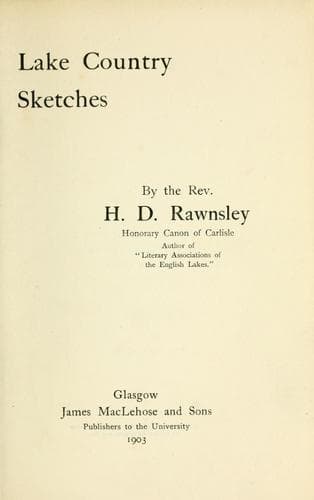
Lake country sketchesRawnsley, H. D. (Hardwicke Drummond)
General
Lake country sketches
Rawnsley, H. D. (Hardwicke Drummond)
Lake District (England); Wordsworth, William, 1770-1850 -- Homes and haunts -- England -- Lake District
Here is Orthwaite or Allerthwaite Hall grim and grey, its little
Elizabethan window mouldings, its diamond squares of glass, its
quaint low-ceilinged dining room. There is a look of drear sadness
and of pale sorrow about the quiet half-hall, half-farmstead, and
there may well be, for its owner William George Browne, the
traveller, went forth therefrom to explore Tartary and Bokhara in the
year 1812, and being suspected by the Persian government of sinister
design, was, under instruction from headquarters, taken captive
beyond the Kizzil Ozan river, blindfolded and barbarously murdered.
Poor Browne! he had better have stayed in sight of harmless Skiddaw,
but his was the gipsy's mind, and though none knew quite why he
journeyed, and his journeys in Africa, Egypt, and Syria show that he
travelled more from love of wild roaming than for aught else, home
for William George Browne had {99} no attraction in its sound. His
was the restless wanderer's heart.
Now we leave the carriage, and while it goes round to pick us up at
Whitefield Cottage on the Uldale and Ireby road, we descend into the
meadows and find ourselves gazing on a large square entrenchment, at
the angles of which were once raised mounds, lying to the south-west
of Overwater. No Roman camp this, for Romans did not place their
camps in the bottoms, unless they had a secure look-out above them,
or a fortified camp on a height near by; and Romans did not when they
dug an entrenchment round their camp, throw the earth out to right
and left and make an embankment either side their fosse, as it is
plain was the case here; besides there is but one entrance to the
camp, and that was not the Roman way. No, the camp we are looking
upon was probably the kraal or stockaded farmstead of a Norse
chieftain, any time between 874 and 950 A.D.
Its owner probably came up the Derwent with Ketel, son of Orme, with
Sweyn and Honig or Hundhr, what time they harried Cumberland under
Ingolf or Thorolf the Dane. For aught we know, he may have been
tempted hither by some sudden surprise-peep he got {100} of the
Overwater tarn and neighbouring meadowland, from the heights of
Skiddaw, the first time he clomb that double-fronted hill.
It is true that a Roman tripod kettle is said to have been discovered
near, but the Romans were not the only nation on the earth that
worked in bronze, and knew the advantage of putting legs to their
kettles; and both in the museum of Copenhagen and Christiania such
tripod kettles may be seen to-day that came from the hands of the
Norsemen of old time.
Public-domain text, read in full here on John Shaqi.
Reviews
Reviews
No reviews yet
Be the first to share your thoughts on this work.
Join the Discussion
Join the discussion
Sign in to leave a comment or review.
Sign InorCreate an account