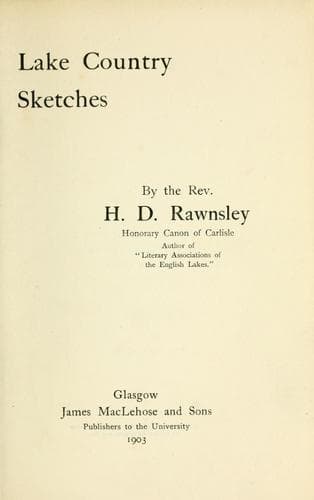
Lake country sketchesRawnsley, H. D. (Hardwicke Drummond)
General
Lake country sketches
Rawnsley, H. D. (Hardwicke Drummond)
Lake District (England); Wordsworth, William, 1770-1850 -- Homes and haunts -- England -- Lake District
By courtesy of the owner we pass in front of the garden, gay with its
flowers, and full of the sense and sweetness of an English country
house. We can hardly gaze at the camp we have come to see, so fair
and beautiful is the vision outstretched before us of Bassenthwaite
laid in gleaming whiteness beneath the dark hills of Wythop and the
purple vastness of Skiddaw, so exquisite the shadowy foldings of the
blue hills that take the eye far up beyond the gates of Borrodale to
Gimmer Crag, to Great-End and far Sea-fell. But when we look at the
camp we have come to see we find ourselves standing on a high
plateau, sheltered on north and east and west by rising ground. The
site of the camp is rectangular, eighty-three feet by thirty-one;
isolated by a trench with regular scarp and counter-scarp. This
trench is twelve feet broad at the bottom, twenty feet at the top;
the scarp and counter-scarp are each nine feet, and the depth is five
feet. The work, to all appearance, is freshly done, and but for the
fact that no pottery has been revealed, might well be work of Roman
engineers. As we wonder at the quaint oblong island of green carved
in {103} the hill side, surrounded by its dry moat, we listen to what
the sages say and archaeologists guess about its origin and intent.
'The remains of a mediaeval pleasaunce,' says one antiquarian.
'Not a bit of it,' says another, 'this was no sheet of water for
ornament, with an island in its midst, this was a Roman sanitary
camp. Hither sick and sorry came the poor fellows, whom the frosts
of Cumberland had pinched, or the dews of Cumberland had rheumatised,
or the malaria of the Derwent Vale had febrified, or the swords and
clubs of the stubborn British had wounded, and here girt round by
friendly fence of water, sheltered from the wind, uplifted in this
quiet pastoral scene, they built their rough wattle hospital, and
prayed to the goddess of health.'
'No, no,' says a third antiquarian, no authority he, and therefore
likeliest to be right. 'This was a battle holme. Here in the olden
time men met for holm-gauge or wager of battle; on that oval sward
was decided, in the sight of the assembled multitude, the feud of
families or the strife of tribes.'
We can, as we gaze, conjure up the whole scene, and hear the crash of
battle hammer, and see the flame of the circling brand; but the {104}
peace of the present subdues the passion of the past, and the sound
of the quiet grass-cropping hard by of the unfearful sheep, the song
of the thrush from the neighbour sycamore recalls us to such pastoral
tranquillity as ill assorts with the stormy drama
'Of old far-off unhappy things
And battles long ago.'
Public-domain text, read in full here on John Shaqi.
Reviews
Reviews
No reviews yet
Be the first to share your thoughts on this work.
Join the Discussion
Join the discussion
Sign in to leave a comment or review.
Sign InorCreate an account