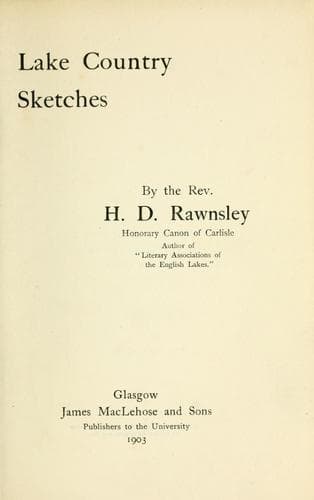
Lake country sketchesRawnsley, H. D. (Hardwicke Drummond)
General
Lake country sketches
Rawnsley, H. D. (Hardwicke Drummond)
Lake District (England); Wordsworth, William, 1770-1850 -- Homes and haunts -- England -- Lake District
But not for ever was there to be war at the gates, even in Roman
times. The cohort gave way to a 'century,' and the centurion, who
remained to keep the way from 'old Carlisle' to Keswick open, was
content to trust his safety from attack to the guardianship of a
single ditch and rampart; and yet the fierceness of fire and sword
must in after times have been felt again at this place. Not many
years ago the ruins of some buildings near the north gate of the
large camp were discovered, that had once been roofed with lead, but
the buildings had been set on fire, and the lead had poured itself
away into the ground. There was nothing to suggest that these
buildings had been of Roman workmanship, and though it is possible
that this was a kind of half-way store-house for the lead miners of
Caldbeck, who were sending their mineral booty to the sea, it is
quite as probable that at some time or other a farmer had here his
'strength' or 'strong house,' and that 'rievers' from over the Border
had made short work of him, and given his farm-stead to the flames.
We leave the Romans of Caermote, and are not surprised to think a
sanatorium hard by was necessary for the cohort of old time, if there
was as much water in the ground as there is {107} to-day within and
without the ramparts. Thence we drive by way of Bewaldeth and the
inn by the Bassenthwaite cross-roads, to the shores of what Southey
called 'westernmost Wythop.' Hardly are we able to get forward, for
the cries of those who are with us in the carriage to draw up, that
we may gaze at this or that wild-rose bush in all its tender
fluttering beauty. But at last we win our goal--Castle How Inn, near
Peelwyke; then scrambling up the hill we inspect the four trenches on
the side of the hill looking towards Peelwyke, whence of old time
gazed out the hardy Britons upon the Roman camp fires blazing at
Caermote.
As we gaze we think not only of Roman times, but of the Viking times
also; for down below us lies the wyke or harbour where the first
Norsemen who ever came up Derwent from the sea ran their boats ashore.
Who, or whence the Norse ancestor of John Peel, who hewed the trees
of the woodland at our feet into planks and built his 'Pride of the
lake,' we cannot know, but he probably had friends, Ketel and Ormr,
and Sweyn, and Honig and Walla, who would from time to time come
across the Crosthwaite Vale and step aboard his galley, and sweep
with flying sail or gleaming oar along by the woods of Mirehouse
{108} or the shadowy cliffs of Barf to his 'steading' here at
Bassenthwaite; and it is more than probable that he and his family
'died into the ground' at Castle How, and there await the glory of
the gods and the coming of Odin.
Public-domain text, read in full here on John Shaqi.
Reviews
Reviews
No reviews yet
Be the first to share your thoughts on this work.
Join the Discussion
Join the discussion
Sign in to leave a comment or review.
Sign InorCreate an account