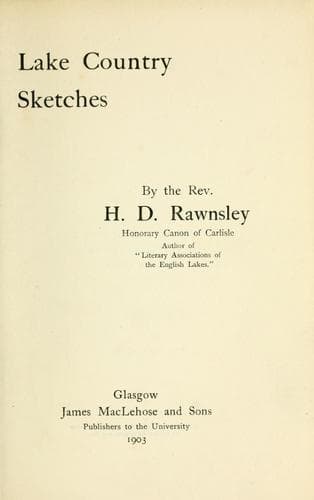
Lake country sketchesRawnsley, H. D. (Hardwicke Drummond)
General
Lake country sketches
Rawnsley, H. D. (Hardwicke Drummond)
Lake District (England); Wordsworth, William, 1770-1850 -- Homes and haunts -- England -- Lake District
In some of the days of close analysis that are coming upon us, poets
will perhaps be found to have depended for the particular colour of
their poems, or turns and cast of thought, upon the kind of
food--vegetable or animal--that they mostly subsisted on. It will be
well to chronicle the fact that Wordsworth had an antipathy to veal,
but was very partial to legs--'lived on legs, you med amost say.'
But as my friend added, almost in the same breath, that the poet was
'a great walker i' t' daäles,' he had uttered unconsciously a double
truth.
The next fact that remained clear and distinct in the butcher's mind
was, that {9} whenever you met the poet he was sure to be 'quite
[pronounced white] plainly dressed.' Sometimes in a round blue cloak;
sometimes wearing a big wideawake, or a bit of an old boxer, but
plainly dressed, almost 'poorly dressed, ya mun saay, at the best o'
times.' 'But for aw that, he was quite an object man,' he added,
meaning that there was a dignity that needed no dressing to set it
off, I suppose, in the poet's mien and manner. It was interesting to
hear, too, how different Wordsworth had seemed in his grave silent
way of passing children without a word, from 'li'le Hartley
Coleridge,' with his constant salutation, uncertain gait, his head on
one side, his walking-stick suddenly shouldered, and then his frantic
little rushes along the road, between the pauses of his thought.
'Many's the time,' said my friend, 'that me and my sister has run
ourselves intil a lather to git clear fra Hartley, for we allays
thowt, ya kna, when he started running he was efter us. But as fur
Mister Wudsworth, he'd pass you, same as if yan was nobbut a stean.
He niver cared for childer, however; yan may be certain of that, for
didn't I have to pass him four times in t' week, up to the door wi'
meat? And he niver oncst said {10} owt. Ye're well aware, if he'd
been fond of children he 'ud 'a spoke.'
But Mrs. Wordsworth had made her impressions too on the youth's mind.
'As for Mrs. Wudsworth, she was plainer in her ways than he was. The
plainest wooman in these parts,--for aw the warld the bettermer part
of an auld farm-body.' He intended nothing disrespectful by this
simile, he only wished to say she was simple in manner and dress.
But if Mrs. Wordsworth's personal appearance had impressed him, her
powers of housekeeping had impressed him more. She was very
persevering, and 'terb'le particular in her accounts, never allowed
you an inch in the butching-book.' It did not raise one's opinion of
Lake country butcher morality to find this a grievance, but the man
as he spoke seemed to think a little sorely of those old-fashioned
days, when mistresses, not cooks, took supervision of the household
economies.
I bade my friend good-day, and the last words I heard were, 'But Mr.
Wudsworth _was quite an object man, mind ye_.'
Public-domain text, read in full here on John Shaqi.
Reviews
Reviews
No reviews yet
Be the first to share your thoughts on this work.
Join the Discussion
Join the discussion
Sign in to leave a comment or review.
Sign InorCreate an account