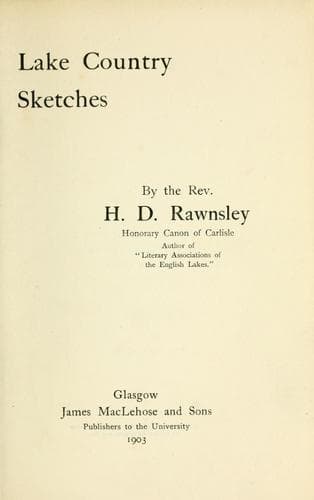
Lake country sketchesRawnsley, H. D. (Hardwicke Drummond)
General
Lake country sketches
Rawnsley, H. D. (Hardwicke Drummond)
Lake District (England); Wordsworth, William, 1770-1850 -- Homes and haunts -- England -- Lake District
People do not realise how fair a view of the whole Skiddaw range is
presented to them as they climb that pass, or they would climb it
oftener. The higher one climbs, the higher does Skiddaw appear, and
deep-bosomed mountain-side in all its massy grandeur of emerald green
and lilac shade in spring, of puce and burnished bronze in autumn,
{169} impresses one with its calm and restfulness. The cloud, sure
sign of fine weather, rests upon its utmost peak to-day, and
irresistibly recalls the lines of Wordsworth's sonnet:
'Veiling itself in mid-Atlantic clouds
To pour forth streams more sweet than Castaly,'
while the pleasant farms with the far-off interchange of happy
cock-crowing, glitter at our feet, and, like an arm of some great
ocean-loch, the white waters of Bassenthwaite come round the
precipice of Barf, and sweep out of the shadow of Wythop woods into
the September sunshine. On our left rises Grasmoor, haunt of the
dottrel, and Hobcarton Crag, beloved of rare mountain flowers. So we
crest the long slope and drop down into Lorton, with the hill-sides
on our right, golden with gorse against the westering sun. Turning
sharply to the left as soon as the village is reached, we pass a kind
of pleasant rural street, if that may be called a street which has
houses only on the one side of it, and just as we emerge into the
country again, find ourself at a spot where the road forks, a portion
of it going over a beck bridge into a farm enclosure by a picturesque
old water-mill and byre, and a portion of it,--the main road {170} to
Loweswater,--bending sharply to the right to go across the valley by
the north side of the stream, which is here hidden from view by a
long barn building. If we pause at this point we cannot help being
struck by the sombre mass of a great yew-tree standing in a pleasant
meadow close to the beck, where at one time there was doubtless a
ford. This is what Wordsworth described as
'A yew-tree, Pride of Lorton Vale,
Which to this day stands single, in the midst
Of its own darkness, as it stood of yore,
Not loth to furnish weapons for the bands
Of Umfraville or Percy ere they marched
To Scotland's heaths; or those that crossed the sea
And drew their sounding bows at Azincour,
Perhaps at earlier Crecy, or Poictiers.
Of vast circumference and gloom profound
This solitary tree!--a living thing
Produced too slowly ever to decay;
Of form and aspect too magnificent
To be destroyed.'
It is not to-day the noble tree it was when Fox was here, and the
prophecy of the poet was only a few years since like to have been
made utterly vain. For its form and aspect was so magnificent that
its owner sold it to a Lorton wood merchant, and it was just about to
be cut down when some memory of Fox's {171} sermon awoke in the
breast of a faithful member of the Society of Friends in the
neighbourhood, and the wood merchant good-naturedly went off his
bargain.
Public-domain text, read in full here on John Shaqi.
Reviews
Reviews
No reviews yet
Be the first to share your thoughts on this work.
Elsewhere in the archive
Join the Discussion
Join the discussion
Sign in to leave a comment or review.
Sign InorCreate an account