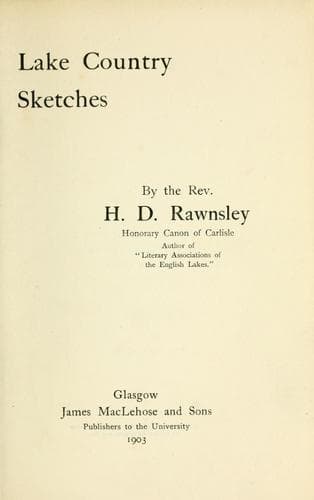
Lake country sketchesRawnsley, H. D. (Hardwicke Drummond)
General
Lake country sketches
Rawnsley, H. D. (Hardwicke Drummond)
Lake District (England); Wordsworth, William, 1770-1850 -- Homes and haunts -- England -- Lake District
It is true that it shows no signs of decay, but it has suffered loss.
Two of its main stems were shattered years ago by a hurricane, and
were sawn off at the bole. Let us go along the road to the farm
buildings, and turn back down to what now serves for a watering-place
for horses. It is thus we shall best get an idea of how 'it stands
single, in the midst of its own darkness.'
The branches stretch their shadow over the stream, and the ripple of
the sunny talkative beck contrasts strangely with the deep silence of
the solemn tree. If we go up to Whinfell Hall and ask a keen
observer of nature and plant life about this famous yew, Mr. Wilson
Robinson will tell us that he once measured the trunk at its least
circumference and found it 23 feet 10 inches, and that, about thirty
years ago, a strong south-east gale came with hurricane force down
Hope Ghyll, wrenched off one of the side limbs and carried away a
third of the tree. Another limb has fallen since then, and yet,
shattered and torn, what a magnificent ruin it {172} is, how well
worth climbing over Whinlatter Pass to visit.
After gazing up the beck towards the picturesque bridge from which we
first surveyed the yew, towards the grand old farmstead and its
cluster of sycamores as a background for the bridge, let us go back
to the bridge and across into the meadow wherein the 'Pride of Lorton
Vale' stands, and, gazing from under the tree towards the west and
south, let us wonder at the beauty of faintly bronzed fern on
Whiteside, the amethystine lilac of the Grasmoor mass, the far-off
cones of Red Pike and High Stile blue above Mellbreak, and far to the
west, Herdhouse ghostly grey; all seeming to join in shutting out the
world and making the quiet emerald meadow in which we stand a
sanctuary for thought and restfulness.
Then let us go back to that day in the year 1653 when George Fox,
having narrowly escaped death by a boy's rapier thrust, and with his
hand and wrist still smarting from the cruel blow of a rough fellow
down at Bootle, where they mobbed him on the previous Sunday, pale
and worn came hither to the ford and found already James Lancaster,
one of his disciples, who had gone forward {173} as an avant-courier
on the way to Cockermouth, busy haranguing the people.
The quiet meadow of to-day was on that day full of armed men. A
detachment of Cromwell's soldiers had been told off from Cockermouth
to keep the peace--it being known that Fox was on his way to Lorton;
and Mr. Larkham, the Congregationalist minister of Cockermouth, and
Priest Wilkinson, the Vicar of Brigham-cum-Mosser-cum-Lorton, were
probably among the crowd that covered the field and stood by the
banks of the stream. 'The people,' we read in Fox's _Journal_, 'lay
up and down in the open, like people at a leaguer.' Fox had seen
something of camp life during the late civil war, and he doubtless
felt that day that, man of peace though he was, the field of the
Lorton yew would be indeed a field of battle for him.
Public-domain text, read in full here on John Shaqi.
Reviews
Reviews
No reviews yet
Be the first to share your thoughts on this work.
Elsewhere in the archive
Join the Discussion
Join the discussion
Sign in to leave a comment or review.
Sign InorCreate an account