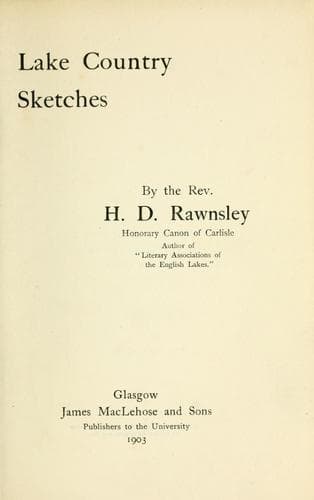
Lake country sketchesRawnsley, H. D. (Hardwicke Drummond)
General
Lake country sketches
Rawnsley, H. D. (Hardwicke Drummond)
Lake District (England); Wordsworth, William, 1770-1850 -- Homes and haunts -- England -- Lake District
John Crozier once received the following note: 'To J. Crozier, Esq.,
M.F.H., from Isaac and Edward Brownrigg, of Brownrigg. This hound
(Darling) brought a splendid dog-fox, and after a very exciting hunt
ultimately caught it in our house field. About an hour afterwards
other five dogs came. After being fed they left, but this one would
not leave. We intend having the fox preserved.' After carrying on
the hounds at his own cost for 30 years, 'the Squire,' as he was
always called, at the request of his neighbours, allowed them to
become a subscription pack, in the year 1870. There was a general
feeling in the dales that it was not fair to allow all the burden to
be upon one man, and on the conditions that he would remain Master,
and in case of the hunt ceasing, the hounds should be returned to
him. A treasurer and secretary were appointed, and the Blencathra
Hunt went on merrily as before.
The Master was fortunate in his huntsmen. Joseph Fearon, of honoured
memory, was succeeded by Isaac Todhunter, who carried the horn for 25
years. Isaac Todhunter handed it on to John Porter, who for a like
time kept up the best traditions of the pack, which Jem Dalton
carries on to-day. The names of {203} these past huntsmen, with
other members of the hunt, are inscribed on the stone of memorial
raised in the Threlkeld Churchyard at the charges of the Squire and a
few friends; and that pillar in the King's dale--for of this dale
John Crozier was truly king--if it does nothing else, goes to prove
that the following of the foxes in the Lake District adds years, even
as it adds cheer, to the lives of the dalesmen. Thus, for example,
one sees that many of the hunters were fourscore years before they
were run to earth; one was 89, another 91, another 95, and a fourth
98.
Up till the past two years the old Master of the hunt presided at the
annual hunt dinner, but it was known that his health was failing, and
though each week up to the end he kept in touch with all the doings
of his pack, he did not leave his house. Still week by week members
of the hunt would go up and have a 'crack' with him--always to be
received with the same courteous inquiry, 'Well, how about your wives
and families, are they well? That's right. Is any news stirring?
What about the House last night?' He took the keenest interest in
politics up to the end, and that came, not unexpectedly, at two
o'clock on a quiet starlit morning, Thursday, 5th March, 1903.
{204}
Public-domain text, read in full here on John Shaqi.
Reviews
Reviews
No reviews yet
Be the first to share your thoughts on this work.
Elsewhere in the archive
Join the Discussion
Join the discussion
Sign in to leave a comment or review.
Sign InorCreate an account