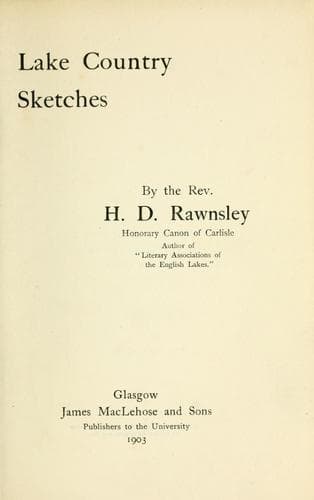
Lake country sketchesRawnsley, H. D. (Hardwicke Drummond)
General
Lake country sketches
Rawnsley, H. D. (Hardwicke Drummond)
Lake District (England); Wordsworth, William, 1770-1850 -- Homes and haunts -- England -- Lake District
I could not wonder that my old friend the yeoman had said it was a
dark day for Threlkeld, for he had lived among his own people, and
loved them to the end. How they loved him may be gathered from the
fact that two days before he died, a casket containing a book in
which every householder in the parish had entered his name, with an
illuminated address, full of affection and gratitude, for the
friendship towards them of a long life, was brought to the house.
'Ya kna,' said my friend, 'they knew t' aid Squire was house-fast,
and they likely thowt 't wad cheer 'im up a laal bit.' He never saw
it, for it was thought he was too ill to be 'fashed' with it, and he
is beyond all earthly cheering now; 'the Hunter is home from the
Hill.'
On the following Monday there was such a gathering together of the
dalesmen from far and near as had never been seen in Threlkeld
Church, or Threlkeld Churchyard. They sang one of the old Squire's
favourite hymns. They bore the coffin to the grave with the
veteran's hunting cap and crop and the brush of the last fox killed
by his pack upon it, and before and after the service they talked of
him kindly, as Cumberland folk ever do of the dead; they spoke of
him, not only as the {205} oldest Master of Foxhounds in the land,
but as a man who entered into all the social enjoyments of the
country-side, and whilst on terms of close intimacy, almost
familiarity, with the companions, retained their regard, and in some
things set them a good example.
For in an age when the gambling spirit was abroad, it will be
remembered that John Crozier never bet a penny in his life. 'I did
yance think o' betting a hawpeth o' snaps,' he once said in the
vernacular; 'but I kind of considered it ower, and I didn't.' It
will be remembered of him, too, that he was against the use of bad
language in the field, and that he never would allow, if he could
help it, a bit of scandal or 'ill gien gossip.' If he heard one man
running down another or passing an unkind judgment, or setting an
unkind tale 'agate,' he would jerk out, 'There, noo, thoo mun let
that hare sit'--and it sat. 'Ay, ay,' said an old friend as he
turned away from the graveyard, 'tho' he said nowt about it, he was a
kind o' a religious man, was varra partial to certain hymns, and had
his favourite psalms, that he wad gang off quietly to his bit
summerhoose most mornings, and tek his prayer book with him. They
say t' housekeeper, after her master's death, found t' aid {206} beuk
laid open on summerhoose taable, I suppose.'
But as they left the churchyard they all in memory saw the old Master
in his sealskin cap, with the lappets about his ears--squarely built
and strong, with his alpenstock in hand, as the prefatory verse tells:
But I think I see him stand,
Rough mountain staff in hand,
Fur cap and coat of grey,
With a smile for all the band
Of the sportsmen in the land,
And a word for all the merry men who loved his 'Hark away!'
Public-domain text, read in full here on John Shaqi.
Reviews
Reviews
No reviews yet
Be the first to share your thoughts on this work.
Elsewhere in the archive
Join the Discussion
Join the discussion
Sign in to leave a comment or review.
Sign InorCreate an account