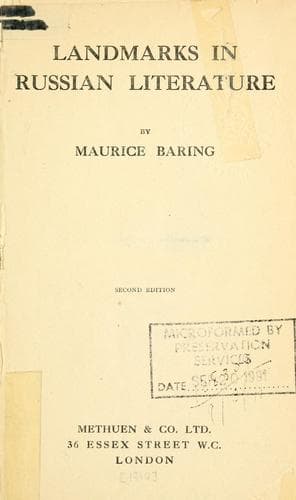
Russian literature -- 19th century -- History and criticism
With regard to the further point, the “prophetic soul” which speaks in
this book is perhaps that which is its most remarkable quality. The
book was some thirty years ahead of its time: ahead of its time in
the same way that Wagner’s music was ahead of its time,--and this was
not only on account of the characters and the state of things which
it divined and foreshadowed, but also on account of the ideas and the
flashes of philosophy which abound in its pages. When the book was
published, it was treated as a gross caricature, and even a few years
ago, when Professor Brückner first published his _History of Russian
Literature_, he talked of this book as being a satire not of Nihilism
itself, but of the hangers-on, the camp-followers which accompany
every army. “Dostoievsky,” he says, “did not paint the heroes but the
Falstaffs, the silly adepts, the half and wholly crazed adherents of
Nihilism. He was indeed fully within his rights. Of course there were
such Nihilists, particularly between 1862 and 1869, but there were not
only such: even Nechaev, the prototype of Petrushka, impressed us by a
steel-like energy and a hatred for the upper classes which we wholly
miss in the wind-bag and intriguer Petrushka.”
There is a certain amount of truth in this criticism. It is true
that Dostoievsky certainly painted the Falstaffs and the half-crazy
adherents of Nihilism. But I am convinced that the reason he did not
paint the heroes was that he did not believe in their existence: he
did not believe that the heroes of Nihilism were heroes; this is plain
not only from this book, but from every line which he wrote about the
people who played a part in the revolutionary movement in Russia; and
so far from the leading personage in his book being merely a wind-bag,
I would say that one is almost more impressed by the steel-like energy
of the character, as drawn in this book, than by the sayings and doings
of his prototype--or rather his prototypes in real life. The amazing
thing is that even if a few years ago real life had not furnished
examples of revolutionaries as extreme both in their energy and in
their craziness as Dostoievsky paints them, real life has done so in
the last four years. Therefore, Dostoievsky not only saw with prophetic
divination that should circumstances in Russia ever lead to a general
upheaval, such characters might arise and exercise an influence, but
his prophetic insight has actually been justified by the facts.
Public-domain text, read in full here on John Shaqi.
Reviews
Reviews
No reviews yet
Be the first to share your thoughts on this work.
Elsewhere in the archive
Join the Discussion
Join the discussion
Sign in to leave a comment or review.
Sign InorCreate an account