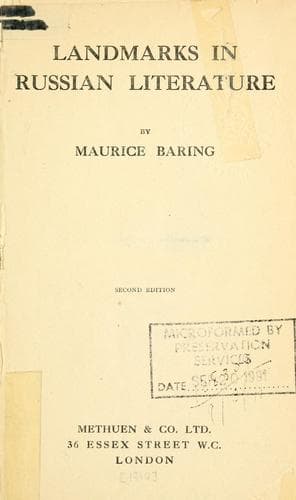
Russian literature -- 19th century -- History and criticism
As soon as Peter discovers Kirilov’s obsession, he extracts from him a
promise that, as he has determined to commit suicide, and that as it is
quite indifferent to him how and when he does it, he shall do it when
it is useful to him, Peter. Kirilov consents to this, although he feels
himself in no way bound to Peter, and although he sees through him
entirely and completely, and would hate him were his contempt not too
great for hatred. But Peter’s most ambitious plans do not consist merely
in binding five men to him by an indissoluble bond of blood: that is
only the means to an end. The end, as I have already said, is vaguely
to get power; and besides the five men whom he intends to make his
slaves for life, Peter has another and far more important trump card.
This trump card consists of a man, Nicholas Stavrogin, who is the hero
of the book. He is the only son of a widow with a landed estate, and
after being brought up by Peter’s father, an old, harmless and kindly
Radical, he is sent to school at the age of sixteen, and later on goes
into the army, receiving a commission in one of the most brilliant of
the Guards regiments in St. Petersburg. No sooner does he get to St.
Petersburg, than he distinguishes himself by savage eccentricities. He
is what the Russians call a _skandalist_. He is a good-looking young
man of Herculean strength, and quiet, pleasant manners, who every now
and then gives way to the wildest caprices, the most extravagant and
astounding whims, when he seems to lose all control over himself. For
a time he leads the kind of life led by Prince Harry with Falstaff,
and his extravagances are the subject of much talk. He drives over
people in his carriage, and publicly insults a lady of high position.
Finally, he takes part in two duels. In both cases he is the aggressor.
One of his adversaries is killed, and the other severely wounded. On
account of this he is court-martialled, degraded to the ranks, and
has to serve as a common soldier in an infantry regiment. But in 1863
he has an opportunity of distinguishing himself, and after a time his
military rank is given back to him. It is then that he returns to the
provincial town, where the whole of the events told in the book take
place, and plays a part in Peter’s organisation. Peter regards him,
as I have said, as his trump card, because of the strength of his
character. He is one of those people who represent the extreme Lucifer
quality of the Russian nature. He is proud and inflexible, without any
trace of weakness. There is nothing in the world he is afraid of, and
there is nothing he will not do if he wishes to do it. He will commit
the wildest follies, the most outrageous extravagances, but as it were
_deliberately_, and not as if he were carried away by the impetuosity
of his temperament. On the contrary, he seems throughout to be as cold
as ice, and eternally unruffled and cool; and he is capable when he
chooses of showing a self-control as astonishing and remarkable as
Public-domain text, read in full here on John Shaqi.
Reviews
Reviews
No reviews yet
Be the first to share your thoughts on this work.
Elsewhere in the archive
Join the Discussion
Join the discussion
Sign in to leave a comment or review.
Sign InorCreate an account