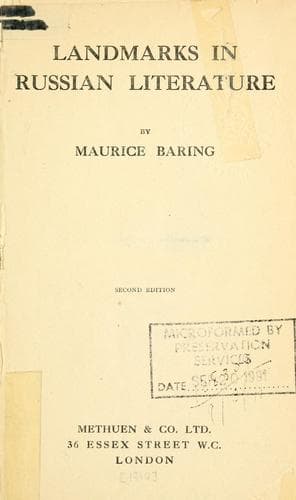
Russian literature -- 19th century -- History and criticism
Tchekov has written in all eleven plays, out of which six are farces
in one act, and five are serious dramas. The farces, though sometimes
very funny, are not important; it is in his serious dramatic work that
Tchekov really found himself, and gave to the world something new and
entirely original. The originality of Tchekov’s plays is not that they
are realistic. Other dramatists--many Frenchmen, for instance--have
written interesting and dramatic plays dealing with poignant
situations, happening to real people in real life. Tchekov’s discovery
is this, that real life, as we see it every day, can be made just as
interesting on the stage as the catastrophes or the difficulties which
are more or less exceptional, but which are chosen by dramatists as
their material because they are dramatic. Tchekov discovered that it is
not necessary for real life to be dramatic in order to be interesting.
Or rather that ordinary everyday life is as dramatic on the stage, if
by dramatic one means interesting, as extraordinary life. He perceived
that things which happen to us every day, which interest us, and affect
us keenly, but which we would never dream of thinking or of calling
dramatic when they occur, may be made as interesting on the stage as
the most far-fetched situations, or the most terrific crises. For
instance, it may affect us keenly to leave for ever a house where we
have lived for many years. It may touch us to the quick to see certain
friends off at a railway station. But we do not call these things
dramatic. They are not dramatic, but they are human.
Tchekov has realised this, and has put them on the stage. He has
managed to send over the footlights certain feelings, moods, and
sensations, which we experience constantly, and out of which our life
is built. He has managed to make the departure of certain people from a
certain place, and the staying on of certain others in the same place,
as interesting behind the footlights as the tragic histories of Œdipus
or Othello, and a great deal more interesting than the complicated
struggles and problems in which the characters of a certain school
of modern dramatists are enmeshed. Life as a whole never presents
itself to us as a definite mathematical problem, which needs immediate
solution, but is rather composed of a thousand nothings, which together
make something vitally important. Tchekov has understood this, and
given us glimpses of these nothings, and made whole plays out of these
nothings.
Public-domain text, read in full here on John Shaqi.
Reviews
Reviews
No reviews yet
Be the first to share your thoughts on this work.
Elsewhere in the archive
Join the Discussion
Join the discussion
Sign in to leave a comment or review.
Sign InorCreate an account