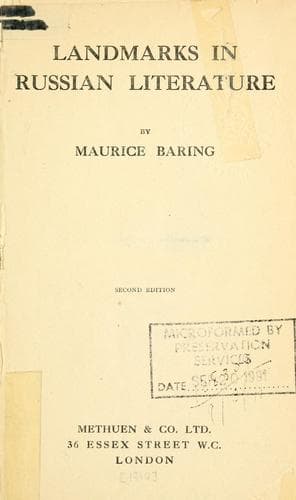
Russian literature -- 19th century -- History and criticism
With regard to Tolstoy the question can be answered without the
slightest hesitation. Time, which has inflicted such mournful damage
on so many great reputations in the last twenty-five years, has not
only left the fame of Tolstoy’s masterpieces unimpaired, but has
increased our sense of their greatness. The question arises, whose work
forms the complement to that of Tolstoy, and shares his undisputed
dominion of modern Russian literature? Is it Tourgeniev? In Russia at
the present day the answer would be “No,” it is not Tourgeniev. And
in Europe, students of Russian literature who are acquainted with the
Russian language--as we see in M. Emile Haumant’s study of Tourgeniev’s
life and work, and in Professor Brückner’s history of Russian
literature--would also answer in the negative, although their denial
would be less emphatic and not perhaps unqualified.
The other giant, the complement of Tolstoy, almost any Russian
critic of the present day without hesitation would pronounce to be
Dostoievsky; and the foreign critic who is thoroughly acquainted with
Dostoievsky’s work cannot but agree with him. I propose to go more
fully into the question of the merits and demerits of Dostoievsky later
on; but it is impossible not to mention him here, because the very
existence of his work powerfully affects our judgment when we come to
look at that of his contemporaries. We can no more ignore his presence
and his influence than we could ignore the presence of a colossal
fresco by Leonardo da Vinci in a room in which there were only two
other religious pictures, one by Rembrandt and one by Vandyck. For
any one who is familiar with Dostoievsky, and has felt his tremendous
influence, cannot look at the work of his contemporaries with the same
eyes as before. To such a one, the rising of Dostoievsky’s red and
troubled planet, while causing the rays of Tourgeniev’s serene star
to pale, leaves the rays of Tolstoy’s orb undiminished and undimmed.
Tolstoy and Dostoievsky shine in the firmament of Russian literature
like two planets, one of them as radiant as the planet Jupiter, the
other as ominous as the planet Mars. Beside either of these the light
of Tourgeniev twinkles, pure indeed, and full of pearly lustre, like
the moon faintly seen in the east at the end of an autumnal day.
* * * * *
Public-domain text, read in full here on John Shaqi.
Reviews
Reviews
No reviews yet
Be the first to share your thoughts on this work.
Join the Discussion
Join the discussion
Sign in to leave a comment or review.
Sign InorCreate an account