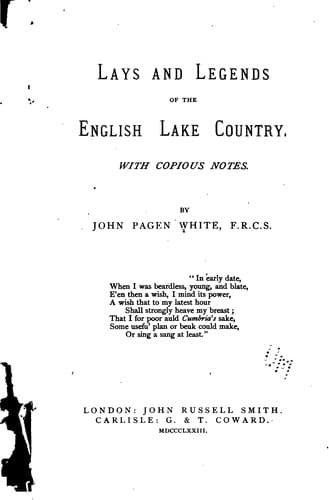
Lays and Legends of the English Lake Country: With Copious NotesWhite, John Pagen
General
Lays and Legends of the English Lake Country: With Copious Notes
White, John Pagen
Lake District (England) -- Poetry; Legends -- England -- Lake District
In the year 1487 Lambert, with about two thousand Flemish troops
under the command of Colonel Martin Swart, a man of noble family
in Germany, an experienced and valiant soldier, whom the Duchess
of Burgundy had chosen to support the pretended title of Simnel to
the crown of England, and a number of Irish, conducted by Thomas
Gerardine their captain from Ireland, landed in Furness at the Pile
of Fouldrey. The army encamped in the neighbourhood of Ulverston,
at a place now known by the name of Swart-Moor. Sir Thomas
Broughton joined the rebels with a small body of English. The army,
at this time about eight thousand strong, proceeded to join the
Earl of Lincoln, Lord Lovel, and the rest of the confederates,
passing on through Cartmel to Stoke field, near Newark-upon-Trent,
where they met and encountered the King's forces on the 5th of
June, 1487.
The day being far advanced before the King arrived at Stoke, he
pitched his camp and deferred the battle till the day following.
The forces of the Earl of Lincoln also encamped at a little
distance from those of the King, and undismayed by the superior
numbers they had to encounter, bravely entered the field the
next day, and arranged themselves for battle, according to the
directions of Colonel Swart and other superior officers. The
charge being sounded, a desperate conflict was maintained with
equal valour on both sides for three hours. The Germans were in
every respect equal to the English, and none surpassed the bravery
of Swart their commander. For three hours each side contended
for victory, and the fate of the battle remained doubtful. The
Irish soldiers, however, being badly armed, and the Germans being
overpowered by numbers, the Lambertines were at length defeated,
but not before their principal officers, the Earl of Lincoln,
Lord Lovel, _Sir Thomas Broughton_, Colonel Swart, and Sir Thomas
Gerardine captain of the Irish, and upwards of four thousand of
their soldiers were slain.
Young Lambert and his tutor were both taken prisoners. The latter,
being a priest, was punished with perpetual imprisonment; Simnel
was too contemptible to be an object either of apprehension or
resentment to Henry. He was pardoned, and made a scullion in the
King's kitchen, whence he was afterwards advanced to the rank of
falconer, in which employment he ended his days.
Public-domain text, read in full here on John Shaqi.
Reviews
Reviews
No reviews yet
Be the first to share your thoughts on this work.
Join the Discussion
Join the discussion
Sign in to leave a comment or review.
Sign InorCreate an account