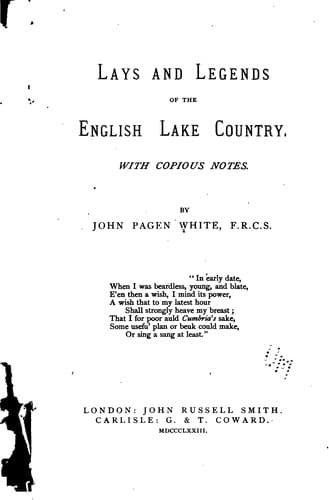
Lays and Legends of the English Lake Country: With Copious NotesWhite, John Pagen
General
Lays and Legends of the English Lake Country: With Copious Notes
White, John Pagen
Lake District (England) -- Poetry; Legends -- England -- Lake District
The lords of Millom are connected with an ancient legend of
Egremont Castle, which is given elsewhere, and which especially
alludes to the horn and hatterell which they bore on their helmets.
This crest is said to have been assumed in the time of Henry I., on
the occasion of the grant of this seignory by the Lord of Egremont
to Godard de Boyvill or Boisville, whose descendants retained
possession of the greater part of it for about one hundred years
when it became vested by marriage in Sir John Hudleston, whose
pedigree is alleged to be traceable for five generations before
the Conquest. In this family it remained for about five hundred
years, when, for failure of male issue it was sold to Sir James
Lowther, nearly a century ago. The names of the first possessors
are now almost forgotten in their own lands. The castle is of
great antiquity. It is uncertain at what date it was originally
built; but it was fortified and embattled by Sir John Hudleston,
in 1335. In ancient times it was surrounded by a fine park, of
which there are some scanty remains on a ridge to the north. The
great square tower is still habitable, though its old battlements
are gone. The castle was invested during the parliamentary war,
and the old vicarage house was pulled down at the same time, "lest
the rebels should take refuge there." There are traces of the
ancient moat still visible. Between the broken pillars of an old
gateway, an avenue leads to the front of the ruin, which, though
not of great extent, presents a fine specimen of the decayed pomp
of early times. The walls of the court yard are all weather-stained
and worn; and, here and there, delicate beds of moss have crept
over them, year after year, so long, that the moist old stones are
now matted with hues of great beauty. The front of the castle is
roofless, and some parts of the massive walls are thickly clothed
with ivy. A fine flight of worn steps leads up through the archway,
to the great tower, in the inner court. Above the archway a stone
shield bears the decayed heraldries of the Hudleston family; and
these arms appear, also, on a slab in the garden wall, and in other
parts of the buildings. The front entrance of the great tower,
from the inner court, when open, shews within a fine old carved
staircase, which leads one to suppose that the interior may retain
many of its ancient characteristics.
Public-domain text, read in full here on John Shaqi.
Reviews
Reviews
No reviews yet
Be the first to share your thoughts on this work.
Elsewhere in the archive
Join the Discussion
Join the discussion
Sign in to leave a comment or review.
Sign InorCreate an account