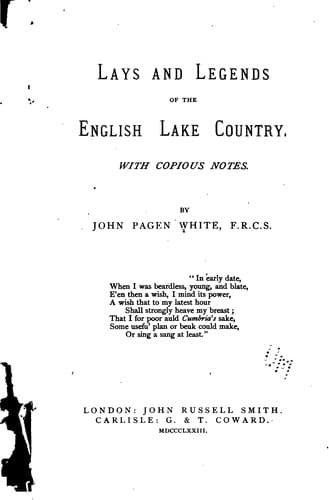
Lays and Legends of the English Lake Country: With Copious NotesWhite, John Pagen
General
Lays and Legends of the English Lake Country: With Copious Notes
White, John Pagen
Lake District (England) -- Poetry; Legends -- England -- Lake District
The church is a venerable building, with its quaint little turret,
containing two bells. The edifice consists of a nave and chancel, a
south aisle, and a modern porch on the same side. The aisle was the
burial place of the Hudlestons. Here is an altar-tomb, ornamented
with Gothic tracery and figures bearing shields of arms, on which
recline the figures of a knight and his lady, in alabaster, very
much mutilated. The knight is in plate armour, his head resting on
a helmet, and having a collar of S.S.; the lady is dressed in a
long gown and mantle, with a veil. They appear to have originally
been painted and gilt, but the greater part of the colouring has
been rubbed off. Near the altar-tomb are the very mutilated remains
of a knight, carved in wood, apparently of the fourteenth century.
A few years ago there was a lion at his feet. A mural marble tablet
to the memory of the Hudleston family is on the wall of the aisle.
The lordship of Millom is the largest seignory within the barony
of Egremont; its ancient boundaries being described as the river
Duddon on the east, the islands of Walney and Piel de Foudray
on the south, the Irish Sea on the west, and the river Esk and
the mountains Hardknot and Wrynose on the north. It anciently
enjoyed great privileges: it was a special jurisdiction into which
the sheriff of the county could not enter: its lords had the
power of life and death, and enjoyed _jura regalia_ in the six
parishes forming their seignory, namely, Millom, Bootle, Whicham,
Whitbeck, Corney, and Waberthwaite. Mr. Denton, writing in 1688,
says that the gallows stood on a hill near the Castle, on which
criminals had been executed within the memory of persons then
living. To commemorate the power anciently possessed by the lords
of this seignory, a stone has recently been erected with this
inscription--"Here the Lords of Millom exercised Jura Regalia."
This lordship still retains its own coroner.
A small nunnery of Benedictines formerly existed within this
seignory, at Lekely in Seaton, which lies westward from Bootle,
near the sea. The precise date of its foundation cannot be
ascertained: but it appears to have taken place on or before the
time of Henry Boyvill, the fourth lord of Millom, who lived about
the commencement of the thirteenth century; and who "gave lands
in Leakley, now called Seaton, to the nuns;" and who in the deed
of feofment of the manor of Leakley made by the said Henry to
Goynhild, his daughter, on her marriage with Henry Fitz-William,
excepts "the land in Leakley which I gave to the holy nuns serving
God and Saint Mary in Leakley."
Public-domain text, read in full here on John Shaqi.
Reviews
Reviews
No reviews yet
Be the first to share your thoughts on this work.
Elsewhere in the archive
Join the Discussion
Join the discussion
Sign in to leave a comment or review.
Sign InorCreate an account