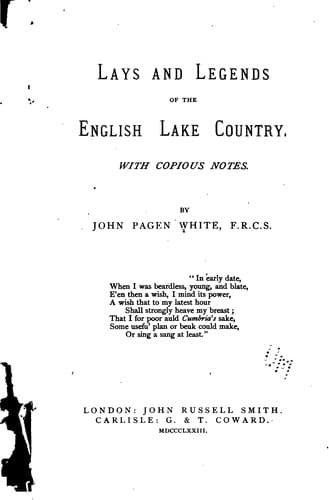
Lays and Legends of the English Lake Country: With Copious NotesWhite, John Pagen
General
Lays and Legends of the English Lake Country: With Copious Notes
White, John Pagen
Lake District (England) -- Poetry; Legends -- England -- Lake District
"Ffour miles southward stands Seaton, an estate of £500 per annum,
sometimes a religious house, got by one Sir Hugo Askew, yeoman of
the sellar to Queen Catherine in Henry Eight's time, and born in
this contry. And when that Queen was divorced from her husband,
this yeoman was destitute. And he applied for help to (the) Lo.
Chamberlain for some place or other in the King's service. The Lord
Steward knew him well, because he had helpt to a cup (of) wine
ther before, but told him he had no place for him but a charcoal
carrier. 'Well' quoth this monsir Askew, 'help me in with one
foot, and let me gett in the other as I can.' And upon a great
holiday, the king looking out at some sports, Askew got a courtier,
a friend of his, to stand before the king; and Askew gott on his
velvet cassock and his gold chine, and basket of chercole on his
back, and marched in the king's sight with it. 'O,' saith the
king, 'now I like yonder fellow well, that disdains not to do his
dirty office in his dainty clothes: what is he?' Says his friend
that stood by on purpose, 'It is Mr Askew, that was yeoman of the
sellar to the late Queen's M^{tie}, and now glad of this poor
place to keep him in your ma^{tie's} service, which he will not
forsake for all the world.' The king says, 'I had the best wine
when he was i'th cellar. He is a gallant wine-taster: let him have
his place againe;' and after knighted him; and he sold his place,
and married the daughter of Sir John Hudleston; (and purchased[6]
this religious place of Seaton, nye wher he was borne, of an
ancient freehold family,) and settled this Seaton upon her, and she
afterwards married monsir Penengton, Lo: of Muncaster, and had Mr.
Joseph and a younger son with Penington, and gave him this Seaton."
A brass plate on the south wall of the chancel of Bootle Church,
bears the effigies of a knight in armour, with the following
inscription in old English characters, indicating his tomb. "Here
lieth Sir Hughe Askew, knyght. late of the seller to Kynge Edward
the VI. which Sir Hughe was made knyght, at Musselborough felde, in
ye yeare of our Lord, 1547, and died the second day of Marche, in
the yere of our Lord God, 1562."
Public-domain text, read in full here on John Shaqi.
Reviews
Reviews
No reviews yet
Be the first to share your thoughts on this work.
Elsewhere in the archive
Join the Discussion
Join the discussion
Sign in to leave a comment or review.
Sign InorCreate an account