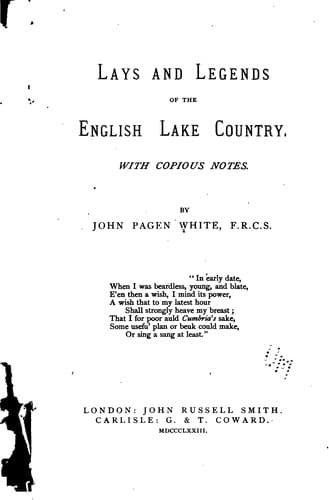
Lays and Legends of the English Lake Country: With Copious NotesWhite, John Pagen
General
Lays and Legends of the English Lake Country: With Copious Notes
White, John Pagen
Lake District (England) -- Poetry; Legends -- England -- Lake District
The nunnery was dedicated to St. Leonard; and was so poor that it
could not sufficiently maintain the prioress and nuns. Wherefore
the Duke of Lancaster, afterwards Henry IV., by his charter, in
1357, granted to them in aid the hospital of St. Leonard, at
Lancaster, with power to appoint the chantry priest to officiate in
the said hospital. At the dissolution the possessions of the priory
were only of the annual value of £12 12s. 6d. according to Dugdale,
or £13 17s. 4d. by Speed's valuation.
When at the suppression of Abbeys it came to the crown, Henry VIII.
gave the site and lands at Seaton to his servant Sir Hugh Askew,
and his heirs. This Knight was descended from Thurston de Bosco,
who lived in the days of King John at a place then called the
Aikskeugh, or Oakwood, near Millom, and afterwards at Graymains,
near Muncaster; and from a poor estate was raised to great honour
and preferment, by his service to King Henry VIII. in his house
and in the field. Anne Askew, whose name stands so eminent in the
annals of martyrology, was one of his descendants.
There are few remains of the convent now left: some part of the
priory-chapel is still standing, particularly a fine window with
lancets, in the style of the thirteenth century. Seton-Hall,
formerly a part of the conventual buildings, and subsequently the
residence of Sir Hugh Askew, is now occupied as a farm house.
Of Seton and Sir Hugh Askew, we have the following quaint story in
Sandford's M.S. account of Cumberland:--
Public-domain text, read in full here on John Shaqi.
Reviews
Reviews
No reviews yet
Be the first to share your thoughts on this work.
Elsewhere in the archive
Join the Discussion
Join the discussion
Sign in to leave a comment or review.
Sign InorCreate an account