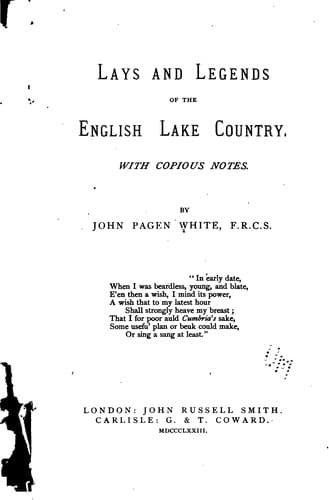
Lays and Legends of the English Lake Country: With Copious NotesWhite, John Pagen
General
Lays and Legends of the English Lake Country: With Copious Notes
White, John Pagen
Lake District (England) -- Poetry; Legends -- England -- Lake District
The result of the next day's resolution was to address themselves
to Thurstan, Archbishop of York, and beg his advice and relief.
The reception they met with from him, answered their wishes; the
Archbishop graciously received them, and charitably entertained
them for some time, then recommended them to Gundrede de Aubigny,
who sent them to Robert de Alneto, her brother, a hermit, at Hode,
in the East Riding of Yorkshire, where for a period she supplied
them with necessaries. They afterwards obtained a monastery of
their own called Byland, when they voluntarily made themselves
dependant upon Savigny, in order that Furness should exercise no
right of paternity over them.
In the same year, 1142, the Abbot of Furness understanding that
Gerold had obtained a settlement, sent another colony, with
Hardred, a Furness monk, for their Abbot, to take possession of
ravaged Calder, which the Lord of Egremont, William Fitz-Duncan,
nephew of David, King of Scots, had refounded. Their endowments
and revenues were chiefly from the founder's munificence, and were
small, being valued, at the suppression, at about sixty pounds per
annum.
The ruins of this Abbey are approached from Calder-Bridge by
a pleasant walk for about a mile on the banks of the river,
presenting several glimpses of the tower rising out of the foliage
of the forest trees by which it is surrounded.
The Abbey Church was in the form of a cross, and small, the width
of the chancel being only twenty five feet, and that of the
transepts twenty two. Of the western front little more than the
Norman doorway remains. The five pointed arches of the north side
of the nave, dividing it from the aisle; the choir; the transepts,
with a side chapel on the south; the square tower supported by four
lofty pointed arches; the walls and windows of a small cloister
running south; with the remains of upper chambers, showing a range
of eight windows to the west and seven to the east, beautiful
specimens of early English Architecture, terminated by a modern
mansion, occupying the site of the conventual buildings, but built
in a style altogether unsuited to the locality; these, with the
porter's lodge at a short distance from the west end, and a large
oven by the side of a rapid stream in the meadow on the east, all
so changed since the times of Gerold and Hardred, constitute in our
days the Abbey of Calder.
Public-domain text, read in full here on John Shaqi.
Reviews
Reviews
No reviews yet
Be the first to share your thoughts on this work.
Elsewhere in the archive
Join the Discussion
Join the discussion
Sign in to leave a comment or review.
Sign InorCreate an account