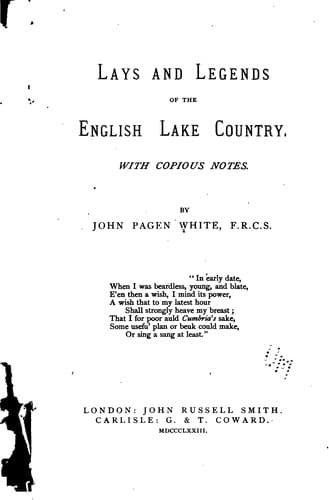
Lays and Legends of the English Lake Country: With Copious NotesWhite, John Pagen
General
Lays and Legends of the English Lake Country: With Copious Notes
White, John Pagen
Lake District (England) -- Poetry; Legends -- England -- Lake District
Against the walls of the Abbey are fragments of various sepulchral
figures, which from the mutilated sculptures and devices on the
shields, would seem to have belonged to the tombs of eminent
persons. One of them is represented in a coat of mail, with his
hand upon his sword; another bears a shield reversed, as a mark
of disgrace for cowardice or treachery; "but," says Hutchinson,
"the virtues of the one, and the errors of the other, are alike
given to oblivion by the hand of time and by the scourging angel
Dissolution."
Sir John le Fleming, of Beckermet, ancestor of the Flemings of
Rydal Hall, Westmorland, gave lands in Great Beckermet to this
abbey, in the 26th year of Henry III, A. D. 1242. He died during
that long reign, and was buried in the abbey. One of the effigies
above alluded to, with the shield charged fretty, is probably that
mentioned by Sir Daniel Fleming, who says that in his time (in the
seventeenth century) here was "a very ancient statue of a man in
armour, with a frett (of six pieces) upon his shield, lying upon
his back, with his sword by his side, his hands elevated in a
posture of prayer, and legs across; being so placed probably from
his taking upon him the cross, and being engaged in the holy war.
Which statue was placed there most probably in memory of this Sir
John le Fleming."
Among some ancient charters and documents in the possession
of William John Charlton, of Hesleyside, Esq., (1830) and
which came into his family, in 1680, by the marriage of his
great-great-grandfather, with Mary, daughter of Francis Salkeld,
in the parish of All-Hallows, in Cumberland, Esq., is one that is
very curious. It is an assignment made in A. D. 1291, by John, son
of John de Hudleston, of William, son of Richard de Loftscales,
formerly his native, with all his retinue and chattels, to the
Abbot and Monks of Caldra. The deed is witnessed by "Willmo.
Wailburthuait. Willmo. Thuaites. Johe de Mordling. Johe Corbet.
Johe de Halle et aliis:" and is alluded to in the following
passages quoted by Mr. Jefferson from _Archælogia Æliana_. "It
is, in fact, that species of grant of freedom to a slave, which
is called manumission implied, in which the lord yields up all
obligation to bondage, on condition of the native agreeing to an
annual payment of money on a certain day. The clause, 'so that
from this time they may be free, and exempt from all servitude and
reproach of villainage from me and my heirs,' is very curious,
especially to persons of our times, on which there has been so much
said about the pomp of Eastern lords, and the reproachful slavery
in which their dependents are still kept. Here the Monks of Caldra
redeemed a man, his family, and property from slavery, on condition
of his paying them the small sum of two pence a-year. The Hudleston
Public-domain text, read in full here on John Shaqi.
Reviews
Reviews
No reviews yet
Be the first to share your thoughts on this work.
Elsewhere in the archive
Join the Discussion
Join the discussion
Sign in to leave a comment or review.
Sign InorCreate an account