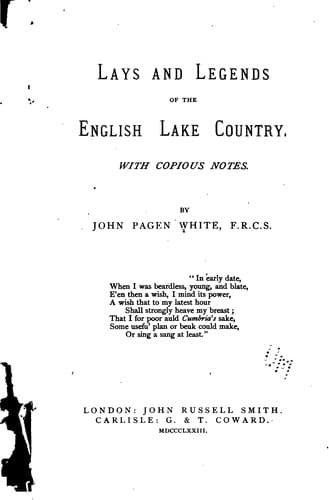
Lays and Legends of the English Lake Country: With Copious Notes — John Shaqi
Lays and Legends of the English Lake Country: With Copious NotesWhite, John Pagen
General
Lays and Legends of the English Lake Country: With Copious Notes
White, John Pagen
Lake District (England) -- Poetry; Legends -- England -- Lake District
The fate of Lord Lovel, another of the chiefs in this disastrous
enterprise, is also shrouded in mystery. It has often been told
that he was never seen, living or dead, after the battle.
The dead bodies of the Earl of Lincoln and most of the other
principal leaders, it was said, were found where they had fallen,
sword-in-hand, on the fatal field; but not that of Lord Lovel. Some
assert that he was drowned when endeavouring to escape across the
river Trent, the weight of his armour preventing the subsequent
discovery of his body. Other reports apply to him the circumstances
similar to those which have been related above as referring to Sir
Thomas Broughton; namely, that he fled to the north where, under
the guise of a peasant, he ended his days in peace. Lord Bacon, in
his History of Henry the Seventh, says "that he lived long after
in a cave or vault." And his account has been partly corroborated
in modern times. William Cowper, Esquire, Clerk of the House of
Commons, writing from Hertingfordbury Park in 1738, says--"In 1708,
upon the occasion of new laying a chimney at Minster Lovel, there
was discovered a large vault or room underground in which was the
entire skeleton of a man, as having been sitting at a table which
was before him, with a book, paper, pen, etc.; in another part
of the room lay a cap, all much mouldered and decayed; which the
family and others judged to be this Lord Lovel, whose exit has
hitherto been so uncertain."
A tradition was rife in the village in the last century to the
effect that, in this hiding place, which could only be opened from
the exterior, the insurgent chief had confided himself to the
care of a female servant, was forgotten or neglected by her, and
consequently died of starvation.
The ancient Castle or Pile of Fouldrey, (formerly called Pele of
Foudra, or Futher,) stands upon a small island near the southern
extremity of the isle of Walney; and is said by Camden to have been
built by an Abbot of Furness, in the first year of King Edward the
Third (A. D. 1327). It was probably intended for an occasional
retreat from hostility; a depository for the valuable articles
of the Monastery of Furness; and for a fortress to protect the
adjoining harbour; all which intentions its situation and structure
were well calculated to answer at the time of its erection.
It seems to have been the custom in the northern parts of the
kingdom, for the monasteries to have a fortress of this kind, in
which they might lodge with security their treasure and records
on the approach of an enemy; of this the Castle on Holy Island,
in Northumberland, and Wulstey Castle, near the Abbey of Holm
Cultram, in Cumberland, are examples. It has even been said that
an underground communication existed between Furness Abbey and the
Pele of Fouldrey.
Public-domain text, read in full here on John Shaqi.
Reviews
Reviews
No reviews yet
Be the first to share your thoughts on this work.
Join the Discussion
Join the discussion
Sign in to leave a comment or review.
Sign InorCreate an account