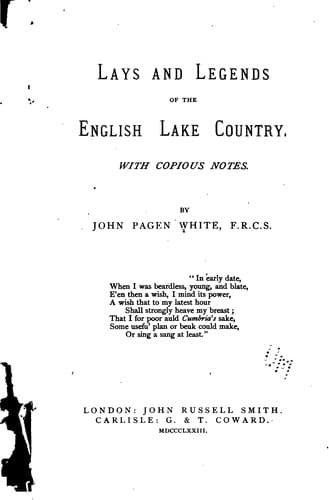
Lays and Legends of the English Lake Country: With Copious NotesWhite, John Pagen
General
Lays and Legends of the English Lake Country: With Copious Notes
White, John Pagen
Lake District (England) -- Poetry; Legends -- England -- Lake District
The tribe of ancient Britons who occupied Cumberland previous
to the Roman conquest, the Brigantes, who were as wild and
uncultivated as their native hills, subsisting principally by
hunting and the spontaneous fruits of the earth; wearing for their
clothing the skins of animals, and dwelling in habitations formed
by the pillars of the forest rooted in the earth, and enclosed by
interwoven branches, or in caves; have left one undoubted specimen
of their race behind them. In the parish of Scaleby, in Cumberland,
the land on the north end is barren, and large quantities of peat
are cut and sent to Carlisle and other places for sale. At the
depth of nine feet in this peat moss, has been found the skeleton
of an ancient Briton, enclosed in the skin of some wild animal, and
carefully bound up with thongs of tanned leather. It is conjectured
that the body must have lain in the moss since the invasion of
Julius Cæsar, and from the position in which the skeleton was
found, grasping a stick about three feet long and twelve inches in
circumference, it is supposed he must have perished accidentally on
the spot. The remains were not long ago in the possession of the
rector and Dr. Graham of Netherhouse.
In this part of the island the Britons were not in the worst
state of mental darkness; these were not ignorant of a Deity,
and they were not idolators. Their druids and bards possessed
all the learning of the age. And it is believed that some of the
Chief Druids had their station in Cumberland, where many of their
monuments still remain, and of these one of the most noble and
extensive of any in the island is the circle near Keswick. It
stands on an eminence, about a mile and a half on the old road
to Penrith, in a field on the right hand. The spot is the most
commanding which could be chosen in that part of the country,
without climbing a mountain. Derwentwater and the vale of Keswick
are not seen from it, only the mountains that enclose them on the
south and west. Latrigg and the huge side of Skiddaw are on the
north: to the east is the open country towards Penrith, with Mell
fell in the distance, where it rises alone like a huge tumulus on
the right, and Blencathra on the left, rent into deep ravines. On
the south east is the range of Helvellyn, from its termination
at Wanthwaite Craggs to its loftiest summits, and to Dunmail
Raise. The lower range of Nathdale Fells lies nearer in a line
parallel with Helvellyn. The heights above Leathes Water, with the
Borrowdale mountains complete the panorama.
Public-domain text, read in full here on John Shaqi.
Reviews
Reviews
No reviews yet
Be the first to share your thoughts on this work.
Elsewhere in the archive
Join the Discussion
Join the discussion
Sign in to leave a comment or review.
Sign InorCreate an account