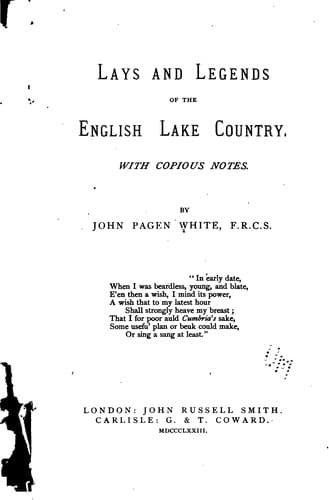
Lays and Legends of the English Lake Country: With Copious NotesWhite, John Pagen
General
Lays and Legends of the English Lake Country: With Copious Notes
White, John Pagen
Lake District (England) -- Poetry; Legends -- England -- Lake District
This circle is formed of stones of various forms, natural and
unhewn, of a species of granite; of a kind, according to Clarke,
not to be found within many miles of this place. The largest is
nearly eight feet high, and fifteen feet in circumference; most of
them are still erect, but some are fallen. They are set in a form
not exactly circular; the diameter being thirty paces from east
to west, and thirty-two from north to south. At the eastern end a
small enclosure is formed within the circle by ten stones, making
an oblong square in conjunction with the stones on that side of the
circle, seven paces in length, and three in width within. At the
opposite side a single square stone is placed at the distance of
three paces from the circle.
Concerning this, like all similar monuments in great Britain, the
popular superstition prevails, that no two persons can number the
stones alike, and that no person will ever find a second count
confirm the first. This notion is curiously illustrated by the
various writers who have described it. According to Gough, Stukely
states the number to be forty; Gray says they are fifty; Hutchinson
makes them fifty; Clarke made them out to be fifty-two; others,
more correctly, forty-eight. Southey says, the number of stones
which compose the circle is thirty-eight, and besides these there
are ten which form three sides of a little square within, on the
eastern side, three stones of the circle itself forming the fourth;
this being evidently the place where the Druids who presided had
their station; or where the more sacred and important part of the
rites and ceremonies (whatever they may have been) were performed.
The singularity noticed in this monument, and what distinguishes it
from all other druidical remains of this nature, is the recess on
the eastern side of the area. Mr. Pennant supposes it to have been
allotted for the Druids, the priests of the place, as a peculiar
sanctuary, a sort of holy of holies, where they met, separated
from the vulgar, to perform their rites, their divinations, or to
sit in council to determine on controversies, to compromise all
differences about limits of land, or about inheritances, or for
the trial of greater criminals. The cause that this recess was on
the east side, seems to arise from the respect paid by the ancient
Britons to Baal or the Sun; not originally an idolatrous respect,
but merely as a symbol of the Creator.
Public-domain text, read in full here on John Shaqi.
Reviews
Reviews
No reviews yet
Be the first to share your thoughts on this work.
Elsewhere in the archive
Join the Discussion
Join the discussion
Sign in to leave a comment or review.
Sign InorCreate an account