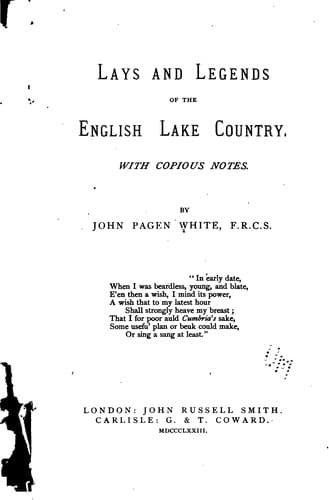
Lays and Legends of the English Lake Country: With Copious NotesWhite, John Pagen
General
Lays and Legends of the English Lake Country: With Copious Notes
White, John Pagen
Lake District (England) -- Poetry; Legends -- England -- Lake District
The neighbourhood of this temple, too, is not without a certain
notoriety on account of the violent floods with which it has been
visited even in modern times. Hutchinson speaks of a remarkable
one caused by impetuous rains, which happened on the twenty-second
of August, 1749, in the vale of St. John's. "The clouds discharged
their torrents like a waterspout; the streams from the mountains
uniting, at length became so powerful a body, as to rend up the
soil, gravel, and stones to a prodigious depth, and bear with them
mighty fragments of rocks; several cottages were swept away from
the declivities where they had stood in safety for a century; the
vale was deluged, and many of the inhabitants with their cattle
were lost. A singular providence protected many lives, a little
school, where all the youths of the neighbourhood were educated,
at the instant crowded with its flock, stood in the very line of
one of these torrents, but the hand of God, in a miraculous manner,
stayed a rolling rock, in the midst of its dreadful course, which
would have crushed the whole tenement with its innocents; and by
its stand, the floods divided, and passed on this hand and on
that, insulating the school-house, and leaving the pupils with
their master, trembling at once for the dangers escaped and as
spectators of the horrid havock in the valley, and the tremendous
floods which encompassed them on every side." He received this
account from one of the people then at school: and also gives the
following description of that inundation, which he had met with.
"It began with most terrible thunder and incessant lightning, the
preceding day having been extremely hot and sultry; the inhabitants
for two hours before the breaking of the cloud, heard a strange
noise, like the wind blowing in the tops of high trees. It is
thought to have been a spout or a large body of water, by which
the lightning incessantly rarifying the air, broke at once on the
tops of the mountains, and descended upon the valley below, which
is about three miles long, half a mile broad, and lies nearly east
and west, being closed on the south and north sides with prodigious
high, steep, and rocky mountains. Legbert Fells on the north side,
received almost the whole cataract, for the spout did not extend
above a mile in length; it chiefly swelled four small brooks, but
to so amazing a degree, that the largest of them, called Catchertz
Ghyll, swept away a mill and other edifices in five minutes,
leaving the place where they stood covered with fragments of rocks
and rubbish three or four yards deep, insomuch that one of the mill
stones could not be found. During the violence of the storm, the
fragments of rock which rolled down the mountain, choked up the
old course of this brook; but the water forcing its way through a
Public-domain text, read in full here on John Shaqi.
Reviews
Reviews
No reviews yet
Be the first to share your thoughts on this work.
Elsewhere in the archive
Join the Discussion
Join the discussion
Sign in to leave a comment or review.
Sign InorCreate an account