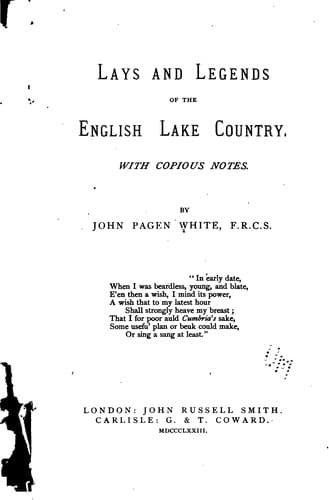
Lays and Legends of the English Lake Country: With Copious NotesWhite, John Pagen
General
Lays and Legends of the English Lake Country: With Copious Notes
White, John Pagen
Lake District (England) -- Poetry; Legends -- England -- Lake District
shivery rock, formed a chasm four yards wide and about eight or
nine deep. The brooks lodged such quantities of gravel and sand
on the meadows, that they were irrecoverably lost. Many large
pieces of rocks were carried a considerable way into the fields;
some larger than a team of ten horses could move, and one of them
measuring nineteen yards about." Clarke says, "Many falsehoods are
related of this inundation: for instance, the insulation of the
school-house with its assembled master and scholars, which, though
commonly told and believed, is not supported by any tradition
of the kind preserved in the neighbourhood." No doubt, the
circumstances are exaggerated: but even his own narrative shows it
to have been one of the most dreadful and destructive inundations
ever remembered in this country. He relates that "all the evening
of that 22nd day of August, horrid, tumultuous noises were heard in
the air; sometimes a puff of wind would blow with great violence,
then in a moment all was calm again. The inhabitants, used to
bosom-winds, whirlwinds, and the howling of distant tempests among
the rocks, went to bed as usual, and from the fatigues of the day
were in a sound sleep when the inundation awoke them. About one
in the morning the rain began to fall, and before four such a
quantity fell as covered the whole face of the country below with
a sheet of water many feet deep; several houses were filled with
sand to the first story, many more driven down; and among the rest
Legberthwaite mill, of which not one stone was left upon another;
even the heavy millstones were washed away; one was found at a
considerable distance, but the other was never discovered. Several
persons were obliged to climb to the tops of the houses, to escape
instantaneous death; and there many were obliged to remain, in a
situation of the most dreadful suspense, till the waters abated.
Mr. Mounsey of Wallthwaite says, that when he came down stairs in
the morning, the first sight he saw was a gander belonging to one
of his neighbours, and several planks and kitchen utensils, which
were floating about his lower apartments, the violence of the
waters having forced open the doors on both sides of the house. The
most dreadful vestiges of this inundation, or waterspout, are at a
place called Lob-Wath, a little above Wallthwaite; here thousands
of prodigious stones are piled upon each other, to the height of
eleven yards; many of these stones are upwards of twenty tons
weight each, and are thrown together in such a manner as to be at
once the object of curiosity and horror.
Public-domain text, read in full here on John Shaqi.
Reviews
Reviews
No reviews yet
Be the first to share your thoughts on this work.
Elsewhere in the archive
Join the Discussion
Join the discussion
Sign in to leave a comment or review.
Sign InorCreate an account