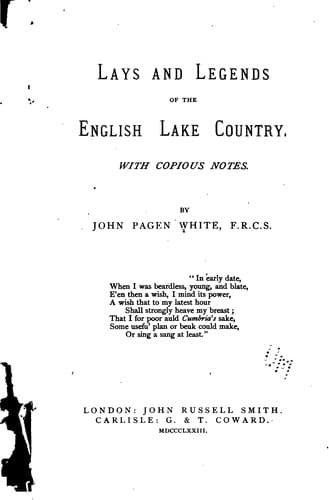
Lays and Legends of the English Lake Country: With Copious NotesWhite, John Pagen
General
Lays and Legends of the English Lake Country: With Copious Notes
White, John Pagen
Lake District (England) -- Poetry; Legends -- England -- Lake District
He charged the proud Butler, that evening to call
To high feast all the maidens and grooms of the Hall;
To send round the bowl, and when mirth flowing high
Brought the heart to the lip, the bright soul to the eye,
At the sound of his footstep to crown their good cheer
With a round to the toast he has breathed in his ear.
Bold and stern, on that evening arose mid the crowd
The bold Butler, and called for a bumper aloud:
Look'd around on the bevy of maidens and men:
Glanced his eye past the Beauty, and spoke out again--
"Who knows what may happen, or what may befall?
Let us drink to the Lady of Workington Hall."
How they stared at each other, how glanced at their Lord,
As he entered that moment and stood by the board,
How they trembled to witness his eye's flashing ray,
Was a sight to be seen that no art can portray.
But the one conscious Maid who could read it alone,
With a shriek, like a vanishing spirit was gone.
But in vain! What the fates have determined will come!
And in time, tired of clangour of trumpet, and drum,
Came the Heir to the Hall of his ancestry old;
Met the Maid of the pitcher once more as he stroll'd;
Woo'd and won her, in spite of whate'er might befall;
And made her the Lady of Workington Hall.
NOTES TO "THE LADY OF WORKINGTON HALL."
The ancient family of the Curwens of Workington can trace their
descent to Ivo de Tailbois and Elgiva daughter of Ethelred, King
of England. Ivo came to England with the Conqueror, was the
first lord of the barony of Kendal, and brother of Fulk, Earl of
Anjou and King of Jerusalem. Ketel, the grandson of Ivo, had two
sons;--Gilbert, the father of William de Lancaster, from whom
descended, in a direct line, the barons of Kendal; and Orme, from
whom descended the Curwens. These took their surname by agreement
from Culwen, a family of Galloway, whose heir they married. It
is said, that Culwen, which is on the seacoast of Galloway, had
its name from a neighbouring rock, which was thought to resemble
a white monk; that being the meaning of the word in the Irish
language. It is also said, that the family name was changed to
Curwen, by a corruption, which first appeared in the public records
in the reign of King Henry VI. Orme having espoused Gunilda,
sister of Waldieve, first lord of Allerdale, received in marriage
with her the manor of Seaton below Derwent, and took up his abode
there. Their son, Gospatrick, received the manors of Workington and
Lamplugh from William de Lancaster in exchange for Middleton, in
Westmorland. He was succeeded by his son Thomas, who became lord of
Culwen in Galloway, and died in 1152, and was buried in the Abbey
of Shap, to which he had been a benefactor; his estates descending
to his second son, Patric de Culwen, who removed his residence from
Seaton to Workington, where his descendants have since remained.
Public-domain text, read in full here on John Shaqi.
Reviews
Reviews
No reviews yet
Be the first to share your thoughts on this work.
Elsewhere in the archive
Join the Discussion
Join the discussion
Sign in to leave a comment or review.
Sign InorCreate an account