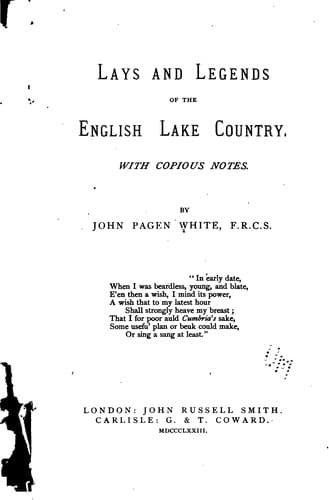
Lays and Legends of the English Lake Country: With Copious NotesWhite, John Pagen
General
Lays and Legends of the English Lake Country: With Copious Notes
White, John Pagen
Lake District (England) -- Poetry; Legends -- England -- Lake District
"The quantity of water which had fallen here is truly astonishing;
more particularly considering the small space it had to collect
in. The distance from Lob-Wath to Wolf-Crag, is not more than a
mile and a half, and there could none collect much above Wolf-Crag;
nor did the rain extend more than eight miles in any direction. At
Melfell only three miles distant, the farmers were leading corn all
night (as is customary when they fear ill weather,) and no rain
fell there; yet such was the fury of the descending torrent, that
the fields at Fornside exhibited nothing but devastation. Here a
large tree broken in two, there one torn up by the root, and the
ground everywhere covered with sand and stones." The rivulet called
Mosedale Beck, which has its source between the mountains Dodd and
Wolf-Crag, was by its sudden and continuous overflow the chief
contributory of the inundation.
FOOTNOTE:
[7] Birth of Christ.
THE LADY OF WORKINGTON HALL.
In her neat country kirtle and kerchief array'd,
A wild little maiden tripp'd through the green shade;
With her pitcher, just filled from the rill, at her side,
And a song on her lip of the Solway's rude tide;
When a rider came by, gallant, youthful, and gay--
"Pretty Maid, let me drink! and good luck to your lay!"
As he glanced o'er the brim, arch and sweet was her smile;
Then "Adieu!" passing on, he sang gaily the while--
"Who knows what may happen, or what may befall?
I may be----" something she could not recall:
For the tramp of his steed mingled in with the tone,
And the burden ceased, broken--the singer was gone.
There are words, notes, and whisperings, broken and few,
That from depths in the soul will oft start up anew,
Like a dream voice, unconsciously, early or late,
Mid all changes of circumstance, fortune, and fate,
Unappealed to, unsought for, unreck'd of, and brought
From afar to the tongue without effort or thought.
And 'twas thus the few notes which she caught of that strain
Often stirr'd on the lips of the Maiden again.
When a child at the school or a maid at the Hall--
"Who knows what may happen, or what may befall?
I may be--" lilted she low, as she sate
At her finger-work meekly, or stroll'd by the gate.
So it chanced as she robed on one morning her bloom
With a mantle of state, in her lost Lady's room;
While the mirror gave back to her sight all her charms;
Came that strain to her lip as she folded her arms--
"Who knows what may happen, or what may befall?
I may be--Lady of Workington Hall!"
Thus the wild-hearted Maid ended gaily the song.
Like a flash from the mirror it glanced from her tongue,
Void of meaning or thought of the future; but lo!
There's a witness beside her the glass does not show.
From a distance unseen are displayed to the eyes
Of her Lord all her pranks in that courtly disguise.
Public-domain text, read in full here on John Shaqi.
Reviews
Reviews
No reviews yet
Be the first to share your thoughts on this work.
Elsewhere in the archive
Join the Discussion
Join the discussion
Sign in to leave a comment or review.
Sign InorCreate an account