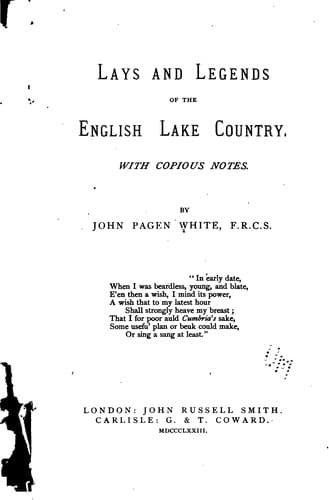
Lays and Legends of the English Lake Country: With Copious NotesWhite, John Pagen
General
Lays and Legends of the English Lake Country: With Copious Notes
White, John Pagen
Lake District (England) -- Poetry; Legends -- England -- Lake District
The description of this remarkable phenomenon, the Helm-Wind,
we will give from observations made by the Rev. John Watson, of
Cumrew, and others. The places most subject to it are Milburn,
Kirkland, Ousby, Melmerby, and Gamblesby. Sometimes when the
atmosphere is quite settled, hardly a cloud to be seen, and not
a breath of wind stirring, a small cloud appears on the summit
of the mountain, and extends itself to the north and south; the
Helm is then said to be on, and in a few minutes the wind is
blowing so violently as to break down trees, overthrow stacks,
occasionally blow a person from his horse, or overturn a horse and
cart. When the wind blows, the Helm seems violently agitated; and
on descending the fell and entering it, there is not much wind.
Sometimes a Helm forms and goes off without a wind; and there are
easterly winds without a Helm. The open space between the Helm and
Bar varies from eight or ten to thirty or forty miles in length,
and from half a mile to four or six miles in breadth; it is of an
elliptical form, as the Helm and Bar are united at the ends. A
representation of the Helm, Bar, and space between, may be made by
opening the forefinger and thumb of each hand, and placing their
tips to each other; the thumbs will then represent the Helm on the
top of the fell, the forefingers the Bar, and the space between,
the variable limits of the wind.
The open space is clear of clouds with the exception of small
pieces breaking off now and then from the Helm, and either
disappearing or being driven rapidly over the Bar; but through
this open space is often seen a high stratum of clouds quite at
rest. Within the space described the wind blows continually; it has
been known to do so for nine days together, the Bar advancing or
receding to different distances. When heard or felt for the first
time it does not seem so very extraordinary; but when heard or felt
for days together, it gives a strong impression of sublimity. Its
sound is peculiar, and when once known is easily distinguished from
that of ordinary winds; it cannot be heard more than three or four
miles, but in the wind or near it, it is grand and awful, and has
been compared to the noise made by the sea in a violent storm.
Its first effect on the spirits is exhilarating, and it gives a
buoyancy to the body. The country subject to it is very healthy,
but it does great injury to vegetation by beating grain, grass, and
leaves of trees, till quite black.
Public-domain text, read in full here on John Shaqi.
Reviews
Reviews
No reviews yet
Be the first to share your thoughts on this work.
Elsewhere in the archive
Join the Discussion
Join the discussion
Sign in to leave a comment or review.
Sign InorCreate an account