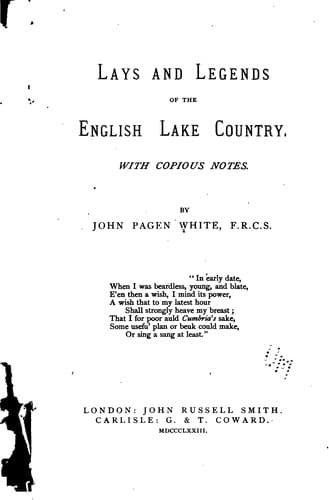
Lays and Legends of the English Lake Country: With Copious NotesWhite, John Pagen
General
Lays and Legends of the English Lake Country: With Copious Notes
White, John Pagen
Lake District (England) -- Poetry; Legends -- England -- Lake District
It may further be remarked of this wind, that it is very irregular,
rarely occurring in the summer months, and more frequent from the
end of September to May. It generally blows from Cross-Fell longest
in the spring, when the sun has somewhat warmed the earth beneath,
and does not cease till it has effectually cooled it; thus it
sometimes continues, according to Mr. Ritson, for a fortnight or
three weeks, which he considers a peculiarity of the Helm wind of
Cross-Fell. The wind itself is very chill, and is almost always
terminated by a rain, which restores, or to which succeeds, a
general warmth, and into which the Helm seems to resolve itself.
The best explanation of this very interesting and remarkable
phenomenon is given in the following observations of Dr. T. Barnes
of Carlisle.
The air or wind from the east ascends the gradual slope of the
eastern side of the Penine chain or Cross-Fell range of mountains,
to the summit of Cross-Fell, where it enters the Helm or cap, and
is cooled to a low temperature; it then rushes forcibly down the
abrupt declivity of the western side of the mountain into the
valley beneath, in consequence of the valley being of a warmer
temperature, and this constitutes the Helm wind.
The sudden and violent rushing of the wind down the ravines and
crevices of the mountains occasions the loud noise that is heard.
At a varying distance from the base of the mountain the Helm wind
is rarified by the warmth of the low ground, and meets with the
wind from the west, which resists its further course. The higher
temperature it has acquired in the valley, and the meeting of the
contrary current, occasion it to rebound and ascend into the upper
region of the atmosphere. When the air or wind has reached the
height of the Helm, it is again cooled to the low temperature of
this cold region, and is consequently unable to support the same
quantity of vapour it had in the valley; the water or moisture
contained in the air, is therefore condensed by the cold, and forms
the cloud called the Helm-Bar.
The meeting of the opposing currents beneath,--where there are
frequently strong gusts of wind from all quarters, and the sudden
condensation of the air and moisture in the Bar-cloud, give rise
to its agitation or commotion, as if "struggling with contrary
blasts." The Bar is therefore not the cause of the limit of the
Helm wind, but is the consequence of it. It is absurd to suppose
that the Bar, which is a light cloud, can impede or resist the
Helm wind; but if it even possessed a sufficient resisting power,
it could have no influence on the wind which is blowing near the
surface of the earth, and which might pass under the Bar.
Public-domain text, read in full here on John Shaqi.
Reviews
Reviews
No reviews yet
Be the first to share your thoughts on this work.
Elsewhere in the archive
Join the Discussion
Join the discussion
Sign in to leave a comment or review.
Sign InorCreate an account