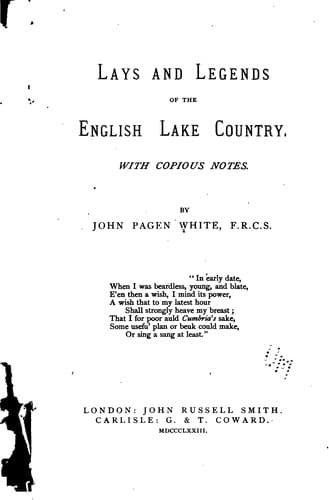
Lays and Legends of the English Lake Country: With Copious NotesWhite, John Pagen
General
Lays and Legends of the English Lake Country: With Copious Notes
White, John Pagen
Lake District (England) -- Poetry; Legends -- England -- Lake District
The variable distance of the Bar from the Helm is owing to the
changing situation of the opposing and conflicting currents, and
the difference of temperature of different parts of the low ground
near the base of the mountain.
When there is a break or opening in the Bar, the wind is said to
rush through with great violence, and to extend over the country.
Here again, the effect is mistaken for the cause. In this case,
the Helm-Wind, which blows always from the east, has, in some
places underneath the observed opening, overcome the resistance
of the air, or of the wind from the west, and of course does not
rebound and ascend into the higher regions to form the Bar. The
supply being cut off, a break or opening in that part of the Bar
necessarily takes place.
When the temperature of the lower region has fallen and become
nearly uniform with that of the mountain range, the Helm wind
ceases; the Bar and the Helm approach and join each other, and rain
not unfrequently follows.
When the Helm-Wind has overcome all the resistance of the lower
atmosphere, or of the opposing current from the west, and the
temperature of the valley and of the mountain is more nearly
equalized, there is no rebound or ascent of the wind, consequently
the Bar ceases to be formed, the one already existing is
dissipated, and a general east wind prevails.
There is little wind in the Helm-cloud, because the air is colder
in it than in the valley, and the moisture which the air contains
is more condensed and is deposited in the cloud upon the summit of
the mountain.
There is rarely either a Helm, Helm-wind, or Bar, during the
summer, on account of the higher temperature of the summit of the
Cross-Fell range, and the upper regions of the atmosphere, at that
season of the year.
The different situations of the Helm, on the side, on the summit,
and above the mountain, will depend on the temperature of these
places: when the summit is not cold enough to condense the vapour,
the Helm is situated higher in a colder region, and will descend
down the side of the mountains if the temperature be sufficiently
low to produce that effect.
The sky is clear between the Helm and Bar, because the air below
is warmer and can support a greater quantity of vapour rising from
the surface of the earth, and this vapour is driven forward by the
Helm-Wind, and ascends up in the rebound to the Bar. In short,
the Helm is merely a cloud or cap upon the mountain, the cold air
descends from the Helm to the valley, and constitutes the Helm
Wind, and when warmed and rarified in the valley, ascends and forms
the Bar.
WILLIE O' SCALES.
Said Willie o' Scales, at break of day,
"The hunt's up! I must busk and away!
Steed, good wife? and saddle? I trow,
Willie o' Scales is steed enow."
Public-domain text, read in full here on John Shaqi.
Reviews
Reviews
No reviews yet
Be the first to share your thoughts on this work.
Elsewhere in the archive
Join the Discussion
Join the discussion
Sign in to leave a comment or review.
Sign InorCreate an account