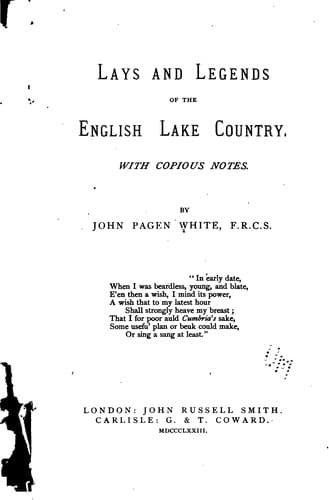
Lays and Legends of the English Lake Country: With Copious NotesWhite, John Pagen
General
Lays and Legends of the English Lake Country: With Copious Notes
White, John Pagen
Lake District (England) -- Poetry; Legends -- England -- Lake District
The Reays of Gill, however variously their name has been spelled
and pronounced by different branches of the family, derived it from
one on whom it was undoubtedly bestowed as being characteristical
and descriptive of himself. The active hunter, the companion and
the friend of William the Lion, was called in the commoner Saxon
language of his time Ra, or Raa, a Roe, from his unparalleled
swiftness. In Scotland and Germany a roe is still pronounced rae,
as it was formerly in England.
"When the deer and the rae
Lightly bounding together,
Sport the lang simmer day
On the braes of Balquhither."
The tradition is that the head, or chief, of this family had a grant
of the lands of Gill to him, and his heirs for ever, from William
the Lion, King of Scotland, whose eventful reign lasted nearly half
a century; and who died in 1214. This grant is said to have been
made, not only as a reward for his fidelity to his prince, but as
a memorial of his extraordinary swiftness of foot in pursuing the
deer, outstripping in fleetness most of the horses and dogs. The
conditions of the grants were, that he should pay a pepper corn
yearly, as an acknowledgment, and that the name of William should,
if possible, be perpetuated in the family. "And this is certain,"
says a writer in the Gentleman's Magazine about the year 1794,
"That ever since, till now, a William Reay has been owner of the
Gill. There is every reason to believe that the present John Reay
is the first instance of a deviation." It is said that even in that
instance the deviation was not made without deliberation; William
the father having first consulted an eminent lawyer, whether he
might safely call his son John. It was replied that mere length of
occupancy would quiet the possession and make the title good.
The great military tenure of lands in this district was by HOMAGE,
FEALTY and CORNAGE. This last (cornage) drew after it _wardship_,
_marriage_, and _relief_. And the service of this tenure was
_knight's service_. HOMAGE was the most honourable service, and
the most humble service of reverence, that a free tenant can do
to his lord. For when he was to do homage to his lord, he was to
appear ungirt, bareheaded, without his sword, and, kneeling on both
knees, his hands held out and clasped between his lord's, was to
say--"I become your man from this day forward of life, and limb,
and earthly honour, and unto you will be true and faithful, and
faith unto you will bear for the tenements that I claim to hold of
you, saving the faith that I owe to our Sovereign Lord the King."
And then the lord so sitting was to kiss him; by which kiss he was
bound to be his vassal for ever.
Public-domain text, read in full here on John Shaqi.
Reviews
Reviews
No reviews yet
Be the first to share your thoughts on this work.
Elsewhere in the archive
Join the Discussion
Join the discussion
Sign in to leave a comment or review.
Sign InorCreate an account