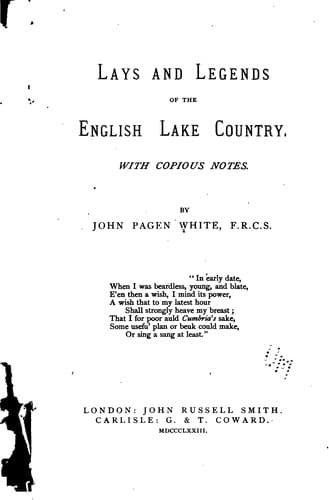
Lays and Legends of the English Lake Country: With Copious NotesWhite, John Pagen
General
Lays and Legends of the English Lake Country: With Copious Notes
White, John Pagen
Lake District (England) -- Poetry; Legends -- England -- Lake District
When a free tenant was to do FEALTY to his lord, he was to hold
his right hand upon a book, and say thus--"Know ye this, my lord,
that I will be faithful and true to you, and faith to you will bear
for the tenements which I claim to hold of you, and that I will
lawfully do to you the customs and services which I ought to do at
the terms assigned; so help me God and his Saints." But he was not
to kneel, nor make such humble reverence as in homage; and fealty
might be done before the steward of the court, but homage could
only be done to the lord himself.
CORNAGE, called also HORNGELD, and NOWTEGELD or (cow-tax) seems
early to have been converted into a pecuniary fine, being a
stipulated payment in the first instance for the finding of
scouts or horners to procure intelligence. It was first paid in
cattle. The tenants who held by cornage were bound to be always
ready to serve the King and lord of the manor on horseback, or on
foot, at their own charge; and when the King's army marched into
Scotland, their post was in the vanguard as they advanced, and in
the vanguard on their return. Because they best knew the passes
and defiles, and the way and manner of the enemy's attacking
and retreating. _Wardship_ and _marriage_ were included in this
tenure. When the tenant died, and the heir male was within the
age of twenty one years, the lord was to have the land holden of
him until the heir should attain that age; because the heir by
intendment of law was not able to do knight's service before his
age of twenty-one years. And if such heir was not married at the
time of the death of his ancestor, then the lord was to have the
wardship and marriage of him. But if the tenant died leaving an
heir female, which heir female was of the age of fourteen years or
upwards, then the lord was not to have the wardship of the land,
nor of the body; because a woman of that age might have a husband
to do knight's service. But if such heir female was under the age
of fourteen years, and unmarried at the time of the death of her
ancestor, the lord was to have the wardship of the land holden of
him until the age of such heir female of fourteen years; within
which time the lord might tender unto her convenable marriage
without disparagement; and if the lord did not tender such marriage
within the said age, she might have entered into the lands, and
ousted the lord.
Public-domain text, read in full here on John Shaqi.
Reviews
Reviews
No reviews yet
Be the first to share your thoughts on this work.
Elsewhere in the archive
Join the Discussion
Join the discussion
Sign in to leave a comment or review.
Sign InorCreate an account