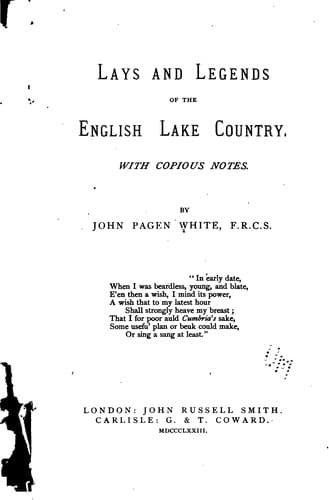
Lays and Legends of the English Lake Country: With Copious NotesWhite, John Pagen
General
Lays and Legends of the English Lake Country: With Copious Notes
White, John Pagen
Lake District (England) -- Poetry; Legends -- England -- Lake District
Thus the consent of a superior lord was requisite for the marriage
of a female vassal; and this power was distorted into the right of
disposing of the ward in marriage. When the King or lord was in
want of money it was by no means unusual to offer the wards, male
or female, with their lands, in a sense to the highest bidder. If
the ward refused to fulfil the marriage so made, then a sum was due
from the estates equal to what they would have fetched.
_Relief_ was a certain sum of money, that the heir, on coming of
age, paid unto the lord, on taking possession of the inheritance of
his ancestor.
A _Knight's fee_ was estimated, not according to the quality but
the quantity of the land, about 640 acres; and the relief was
after the rate of one fourth part of the yearly value of the fee.
The _lord's rent_ was called _white money_, or _white rent_, from
its being paid in silver.
SCUTAGE or service of the shield, was another compensation in
money, instead of personal service against the Scots.
The DRENGAGE tenure, which prevailed about Brougham and Clifton,
was extremely servile. The tenants seem to have been drudges to
perform the most laborious and servile offices. Dr. Burn quotes
authority to prove that Sir Hugh de Morville in Westmorland changed
drengage into free service; and that Gilbert de Brougham gave one
half of the village of Brougham to Robert de Veteripont to make
the other half free of drengage. One of the de Threlkelds also,
who lived at Yanwath Hall, in the time of Edward I., relieved his
tenants at Threlkeld of servile burdens at four pence a head. The
services were half a draught for one day's ploughing; one day's
mowing; one of shearing; one of clipping; one of salving sheep; one
carriage load in two years, not to go above ten miles; to dig and
load two loads of peat every year--the tenants to have their crowdy
(a coarse mess of meal, dripping and hot water) while they worked;
the cottagers the same, only they found a horse and harrow instead
of the half plough, and a footman's load, not a carriage load.
Many of these have long been lost sight of; and now most of the
lands, whether held on customary or arbitrary tenures, merely pay
an almost nominal rent, besides certain fines, to the lord of the
manor. Nevertheless there is much truth in what Blackstone says:
that "copy holders are only villeins improved."
Public-domain text, read in full here on John Shaqi.
Reviews
Reviews
No reviews yet
Be the first to share your thoughts on this work.
Elsewhere in the archive
Join the Discussion
Join the discussion
Sign in to leave a comment or review.
Sign InorCreate an account