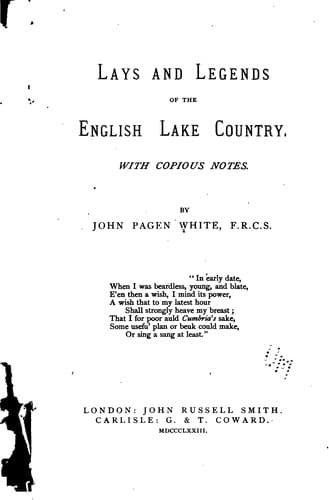
Lays and Legends of the English Lake Country: With Copious NotesWhite, John Pagen
General
Lays and Legends of the English Lake Country: With Copious Notes
White, John Pagen
Lake District (England) -- Poetry; Legends -- England -- Lake District
"In the name of the Blessed Trinity, and in honour of St. Mary
of Furness, I Stephen, earl of Bulloign and Mortaign, consulting
God, and providing for the safety of my own soul, the soul of my
wife the countess Matilda, the soul of my lord and uncle Henry
king of England and duke of Normandy, and for the souls of all the
faithful, living as well as dead, in the year of our Lord 1127 of
the Roman indiction, and the 5th and 18th of the epact:
"Considering every day the uncertainty of life, that the roses and
flowers of kings, emperors, and dukes, and the crowns and palms
of all the great, wither and decay; and that all things, with an
uninterrupted course, tend to dissolution and death:
"I therefore return, give and grant, to God and St. Mary of
Furness, all Furness and Walney, with the privilege of hunting;
with Dalton, and all my lordship in Furness, with the men
and everything thereto belonging, that is, in woods and in
open grounds, in land and in water; and Ulverston, and Roger
Braithwaite, with all that belongs to him; my fisheries at
Lancaster, and Little Guoring, with all the land thereof; with
sac[10], and soc[11], tol[12], and team[13], infangenetheof[14],
and every thing within Furness, except the lands of Michael Le
Fleming; with this view, and upon this condition, That in Furness
an order of regular monks be by divine permission established:
which gift and offering I by supreme authority appoint to be for
ever observed: and that it may remain firm and inviolate for ever,
I subscribe this charter with my hand; and confirm it with the sign
of the Holy Cross.
"Signed by
Henry, King of England and Duke of Normandy.
Thurstan, Archbishop of York.
Audin, } Bishops.
Boces, }
Robert, Keeper of the Seal.
Robert, Earl of Gloster."
The magnitude of the Abbey may be known from the dimensions
of the ruins; and enough is standing to show the style of the
architecture, which breathes the same simplicity of taste which
is found in most houses belonging to the Cistercian monks, which
were erected about the same time with Furness Abbey. The round and
pointed arches occur in the doors and windows. The fine clustered
Gothic and the heavy plain Saxon pillars stand contrasted. The
walls shew excellent masonry, are in many places counter-arched,
and the ruins discover a strong cement. But all is plain: had the
monks even intended, the stone would not admit of such work as has
been executed at Fountains and Rieval Abbeys. The stone of which
the buildings have been composed is of a pale red colour, dug from
the neighbouring rocks, now changed by time and weather to a tint
of dusky brown, which accords well with the hues of plants and
shrubs that everywhere emboss the mouldering arches.
Public-domain text, read in full here on John Shaqi.
Reviews
Reviews
No reviews yet
Be the first to share your thoughts on this work.
Elsewhere in the archive
Join the Discussion
Join the discussion
Sign in to leave a comment or review.
Sign InorCreate an account