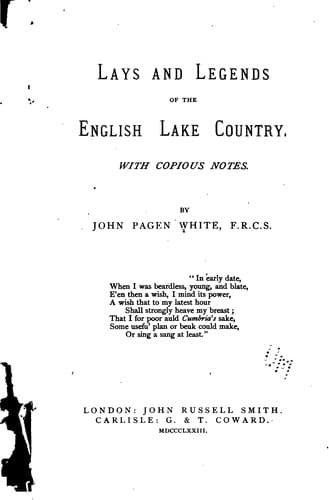
Lays and Legends of the English Lake Country: With Copious NotesWhite, John Pagen
General
Lays and Legends of the English Lake Country: With Copious Notes
White, John Pagen
Lake District (England) -- Poetry; Legends -- England -- Lake District
The church and cloisters were encompassed with a wall, which
commenced at the east side of the great northern door, and formed
the strait enclosure; and a space of ground, to the amount of
sixty-five acres, was surrounded with a strong stone wall, which
enclosed the porter's lodge, the mills, granaries, ovens, kilns,
and fish-ponds belonging to the Abbey, the ruins of which are
still visible. This last was the great enclosure, now called the
deer-park, within which, placed on the crown of an eminence that
rises immediately from the Abbey, and seen over all low Furness,
are the remains of a beacon or watch-tower, raised by the society
for their further security, and commanding a magnificent prospect.
The door leading to it is still remaining in the enclosure wall, on
the eastern side.
During the residence of the monks at Tulket, and until the election
of their fifth Abbot (Richard de Bajocis) they were of the order
of Savigny under the rule of St. Benedict; and from their habit
or dress were called Grey Monks; but at the time of the general
matriculation of the Savignian monasteries with that of Citeaux,
the monks of Furness also accepted of the reform, exchanged their
patron St. Benedict for St. Bernard, changed their dress from grey
to white, and so became White Monks, Bernardins, or Cistercians,
the rule of which order they religiously observed until the
dissolution of the monasteries.
Public-domain text, read in full here on John Shaqi.
Reviews
Reviews
No reviews yet
Be the first to share your thoughts on this work.
Elsewhere in the archive
Join the Discussion
Join the discussion
Sign in to leave a comment or review.
Sign InorCreate an account