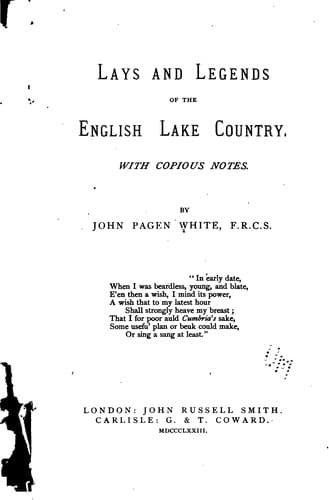
Lays and Legends of the English Lake Country: With Copious NotesWhite, John Pagen
General
Lays and Legends of the English Lake Country: With Copious Notes
White, John Pagen
Lake District (England) -- Poetry; Legends -- England -- Lake District
First came the commissioners appointed by the King for visiting
the monasteries in the North of England, with their searching
examination into everything connected with each separate society:
next, the list of crimes charged on the monks at the time of the
visitation: then the devices of the Earl of Sussex "advertised" in
his letter to the King, wherein "I, the said erle, devising with
myselfe, yf one way would not serve, how, and by what other means,
the said monks might be ryd from the said abbey;" the summons to
Whalley of the unhappy Abbot to make his proposal, in his own
handwriting, according to the "ded enrolled, which A. Fitzherbert
hath drawn" for the surrender of his monastery to the King: and
then the final consummation of all. For come it must. On the 7th
day of April, 1537, in spite of prayers to the "kynge," in spite
of many a "shillinge in golde" given to the "right honerable and
our singler goode Mr. Mayster Thomas Cromwell, secretarie to the
Kynge's highness," the royal commissioners came down upon their
prey. After hanging the Abbot of Whalley, and the royal injunction
that "all monks and chanons, that be in any wise faultie, are _to
be tyed uppe without further delay or ceremonie_," the Abbot of
Furnesse is found "to be of a very facile and ready minde," and
all hope of averting his doom being over, and his sense of peril
hastening his submission, "it coming freely of himself and without
enforcement," he signed the fatal deed of surrender, confessing
with contrition "the mysorder and evil lyfe both to God and our
prynce of the brethren of this monasterie;" the pen passed from the
hand of the Superior to each monk in succession, and the "lamp on
the altar of St. Mary of Furness was extinguished for ever."
With forty shillings given to them by the King, and clad in
"secular wedes" (that is, lay garments), without which they were
not permitted to depart, they turned their faces from their
magnificent home in the Nightshade Dell. To the degraded Abbot was
given the Rectory of Dalton, valued at £33 6s. 9d. yearly, obtained
with difficulty, and even of which he was not allowed undisturbed
possession. But no traces of his associates at the Abbey appear to
have survived their departure from it, unless we dimly discern them
in the miserable record which relates that sixteen years after the
period of their dissolution, fifteen pounds[16] were still paid in
annuities out of the revenues of the late monastery; that noble
possession which the hapless Thirty surrendered to the King.
Public-domain text, read in full here on John Shaqi.
Reviews
Reviews
No reviews yet
Be the first to share your thoughts on this work.
Elsewhere in the archive
Join the Discussion
Join the discussion
Sign in to leave a comment or review.
Sign InorCreate an account