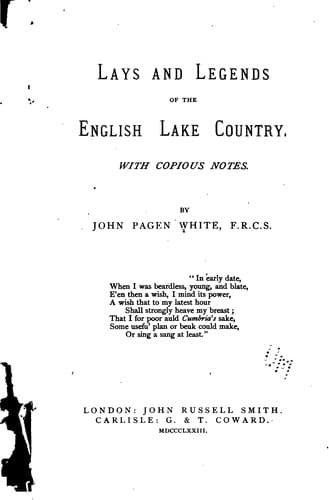
Lays and Legends of the English Lake Country: With Copious NotesWhite, John Pagen
General
Lays and Legends of the English Lake Country: With Copious Notes
White, John Pagen
Lake District (England) -- Poetry; Legends -- England -- Lake District
Of the petty rulers of these British kingdoms no notices have been
transmitted to us. These are confined to the kings of Strathclyde,
or, as they are designated by our earliest informers, of Alclyde;
the latter being the name of their capital, which stood on a rocky
eminence, adjacent to the modern town of Dumbarton; whilst the
former significantly describes the position of their territory
in the great strath or valley of the Clyde. This little district
(of Strathclyde), which must not be confounded with the larger
territory of Cumbria, that as yet had no existence under any
general government or common name, comprised the modern counties of
Lanark, Ayr, and Renfrew, on the south of the Clyde, and, probably,
Dumbartonshire on the north. In the series of Strathclydian kings,
tradition has placed the name of the celebrated King Arthur;
and the local nomenclature is said to afford many traces of his
fame, especially in the case of their citadel of Alclyde, or
Dumbarton, which is styled "Castrum Arthuri," in a record of the
reign of David the Second. Ryderic, the successor of Arthur, died
in 601, in the eighth year of the reign of Ethelfrith, king of
Northumberland; and from that time onward, during the remainder
of this and the succeeding reigns of Edwin and Oswald, we hear
nothing of the independent existence of this people, nor do we
even know the names of their chieftains; it is probable that they
had been reduced to subjection. But in the very year of Oswald's
disastrous death, A. D. 642, we find the Britons carrying on
important military operations on their own account, in which Owen
their king distinguished himself, by slaying on the battle-field
of Strath-carmaic, Donal Break, king of the Scots. During the
long reign of Oswi in Northumberland, we read of one king of
Strathclyde, Guinet, but the record is only of his death, A.
D. 657, not of any exploit which he performed. On the death of
Ecgfrith, A. D. 670, the Britons of Strathclyde appear to have
recovered their liberty; and thenceforward we have a tolerably
complete list of their kings during the two succeeding centuries.
Public-domain text, read in full here on John Shaqi.
Reviews
Reviews
No reviews yet
Be the first to share your thoughts on this work.
Elsewhere in the archive
Join the Discussion
Join the discussion
Sign in to leave a comment or review.
Sign InorCreate an account