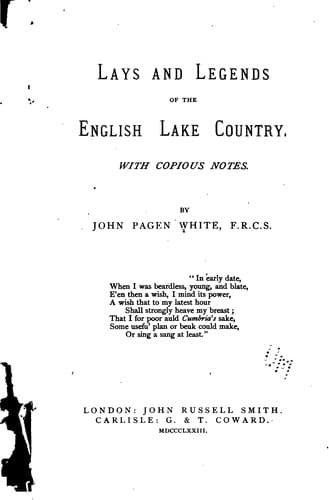
Lays and Legends of the English Lake Country: With Copious NotesWhite, John Pagen
General
Lays and Legends of the English Lake Country: With Copious Notes
White, John Pagen
Lake District (England) -- Poetry; Legends -- England -- Lake District
Ethelfrith, who had effected the conquest of the central and
western portion of Northumbria, and may be regarded as the founder
of the Northumbrian kingdom, "conquered," as we read in Beda, "more
territories from the Britons than any other king or tribune;" but
although he was thus able to overrun a vast district of country,
his followers were not sufficiently numerous to colonise it. In
some places, indeed, "he expelled the inhabitants, and placed
Angles in their stead," but "in others," and doubtless to a
much greater extent, "he allowed the vanquished to retain their
lands, on payment of tribute." In the reign of Edwine, too, the
Anglo-Saxon population were under his immediate government; the
petty British States were still ruled by tributary princes. And no
doubt their political condition continued more or less the same
during the century and half which preceded the dissolution of the
Heptarchy, and after the reconstruction of its several parts under
one crown.
On Northumbria being overrun by the renowned Danish Viking
Healfdene, A. D. 875, fifty years after the Heptarchal kingdoms
had been dissolved, it is recorded that the indigenous inhabitants
of the part called Cymriland, the Cumbrians, or Britons, being
too weak to defend themselves from the hateful aggressions of
the Danes, and deprived of the protection of the Saxon kings of
Northumbria, who had themselves succumbed to the common enemy,
turned for aid to the only neighbours who seemed sufficiently
powerful to resist the invaders. They therefore implored the
aid of Grig or Gregory, king of Scotland, by whose assistance
in the following year the Scandinavian ravagers were expelled.
These Indigenoe, or British inhabitants, must have been the
people of Galloway, and of the district around Carlisle; for the
Strathclyde Britons were already under the authority of Gregory,
as the guardian of Eocha, a minor, who, as the son of Hu king
of Strathclyde, and nephew of the second Constantine, king of
Scotland, succeeded to the crowns of both these realms. Whether
the Britons subsequently quarrelled with their powerful ally, and
being defeated in battle, were obliged to cede to the victor their
rocky highlands and adjacent places; or they voluntarily submitted
themselves to Gregory, with their lands and possessions, thinking
it preferable to be subject to the Scots, who, although enemies,
were Christians, than to infidel pagans, there does not appear to
be any evidence to determine.
Public-domain text, read in full here on John Shaqi.
Reviews
Reviews
No reviews yet
Be the first to share your thoughts on this work.
Elsewhere in the archive
Join the Discussion
Join the discussion
Sign in to leave a comment or review.
Sign InorCreate an account