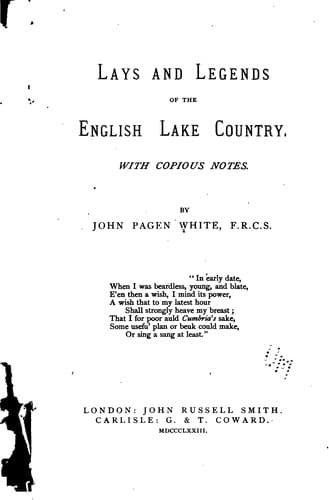
Lays and Legends of the English Lake Country: With Copious NotesWhite, John Pagen
General
Lays and Legends of the English Lake Country: With Copious Notes
White, John Pagen
Lake District (England) -- Poetry; Legends -- England -- Lake District
Another account says, that having dashed forward down the principal
aisle of the church, and having discovered that his principal
object could not be effected, he was making his escape by another
aisle, when his head came violently in contact with the arch of
the doorway, which was much lower than that through which he had
entered; that his helmet was struck off by the blow, his saddle
girth gave way, and he himself, much stunned, was thrown to the
ground.
At this instant his party made a furious attack on the assailants,
who taking advantage of his mishap, attempted to detain him; and
the Major killed with his own hand the man who had seized him,
clapped the saddle, ungirthed as it was, upon the horse, and
vaulting into it, rode full speed through the streets of Kendal,
calling his men to follow him, and with his whole party made a
safe retreat to his asylum on the lake, which he reached about two
o'clock.
The action marked the man. Many knew him; and they who did not,
knew as well from the exploit, that it could be nobody but _Robin
the Devil_.
In the Bellingham Chapel, in Kendal Church, is suspended high over
an ancient altar tomb, a battered helmet, through whose crust of
whitewash the rust of ages is plainly to be discerned. Whether this
antique casque belonged to Sir Roger Bellingham, who was interred
A. D. 1557 in the tomb beneath, and was exalted as a token of
the distinction he had received, when made a knight banneret by
the hand of his sovereign on the field of battle, or was won by
the puissant burgesses of Kendal from one of the Philipsons, and
elevated to its present position as a trophy of their valour, it
is, strangely enough, called the "Rebel's Cap," and forms the theme
of the bold and sacreligious action recorded of Robert Philipson.
As for "Robin" (who has also, though unjustly, been calumniated
and accused of having murdered the persons to whom the skulls at
Calgarth belonged, and who figures, it is said, in many other
desperate adventures), after the final defeat at Worcester had,
by depressing for a time the hopes of the royalists, in some
degree restored a sort of subdued quiet to the kingdom, finding a
pacific life irksome to his restless spirit, he passed over into
the sister country, and there fell in some nameless rencontre in
the Irish wars, sealing by a warrior's fate a course of long tried
and devoted attachment to his king; in his death, as in his life,
affording a memorable illustration of the fine sentiment embodied
in these proud lines--
"Master! lead on and I will follow thee
To the last gasp, with truth and loyalty."
During the Protectorate of Cromwell, Briggs ruled in the
ascendancy; but on the accession of Charles the Second, he was
obliged for a long period to hide in the wilds of Furness.
Public-domain text, read in full here on John Shaqi.
Reviews
Reviews
No reviews yet
Be the first to share your thoughts on this work.
Elsewhere in the archive
Join the Discussion
Join the discussion
Sign in to leave a comment or review.
Sign InorCreate an account