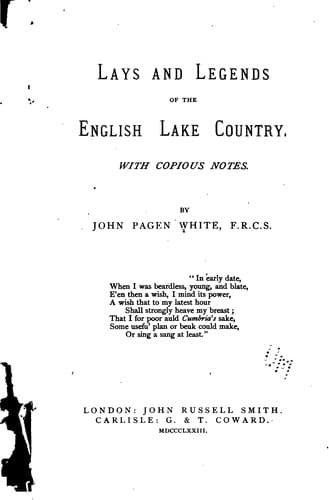
Lays and Legends of the English Lake Country: With Copious NotesWhite, John Pagen
General
Lays and Legends of the English Lake Country: With Copious Notes
White, John Pagen
Lake District (England) -- Poetry; Legends -- England -- Lake District
Two hundred years have rolled away, since the generation that
saw those events has vanished from the earth, and every tangible
memorial of the island hero has been thought to have perished with
him. Nevertheless, time has spared one fragile, though little
noticed relic; for in the library of that most interesting of
our northern English fanes, the Parish Church of Cartmel, whose
age-stricken walls, so rich in examples of each style of Gothic
architecture, rise but a few miles from the foot of the lake, in
the centre of a vale of much beauty of a monastic character, there
is retained upon the shelves a small volume in Latin, entitled
"Vincentii Lirinensis hæres, Oxoniæ, 1631," on one of the blank
leaves of which is this inscription in MS., the signature to which
has been partly torn off:--
"For Mr Rob. Philipson.
Inveniam, spero, quamvis Peregrinus, amicos:
Mite peto tecum cominus hospitium. R----"
It is pleasing to dwell on this enduring testimony of regard for
a man, whose portrait, as limned on the historic canvas, has
hitherto been looked upon as that only of a bold unnurtured ruffler
in an age of strife. Seen under the effect of this touch by the
hand of friendship, a gentler grace illumes the air of one, whose
unwavering principles and firm temper well fitted him to encounter
the troubles of a stormy epoch, while, as long as the island itself
shall endure, his heroic shadow rising over its groves, will cast
the enthralling interest of a romantic episode upon a scene so
captivating by its natural loveliness.
That the individual so addressed, was our Robin of Satanic
notoriety, there cannot reasonably be a doubt, as the pedigree of
the Crook Hall Philipsons does not recognise any other member of
the family of that name, living between the time of the publication
of the book, and the death of their last male heir. Neither is the
genealogical tree of the Calgarth branch enriched with the name
between that and 1652, when Christopher Philipson (of the house of
Calgarth) who, amid the bitter struggle of parties, seems to have
been devoted to the cultivation of letters, and who is supposed
to have presented the book, along with others, to the library at
Cartmel, died. Therefore to the successful soldier, whose actions
gave to himself and his cause so chivalrous a colouring, alone,
must the inscription be applied, the evidence it affords furnishing
another illustration of the saying that "the Devil is not always
as black as he is painted." But whether it be questionable that
it was directed to the royalist Robin, or not, the probability is
sufficiently great to justify what has been said on the subject.
Public-domain text, read in full here on John Shaqi.
Reviews
Reviews
No reviews yet
Be the first to share your thoughts on this work.
Elsewhere in the archive
Join the Discussion
Join the discussion
Sign in to leave a comment or review.
Sign InorCreate an account