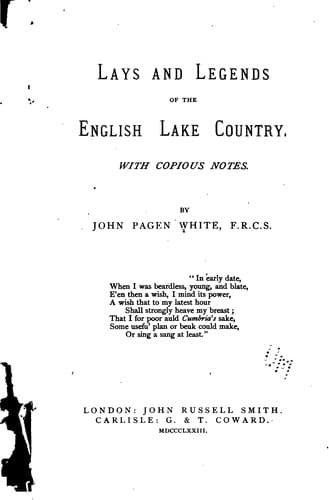
Lays and Legends of the English Lake Country: With Copious NotesWhite, John Pagen
General
Lays and Legends of the English Lake Country: With Copious Notes
White, John Pagen
Lake District (England) -- Poetry; Legends -- England -- Lake District
These two daughters and co-heiresses of Lucy having married the two
sons of Thomas de Multon, the elder carried with her the lordship
of Egremont; while the son of the younger assumed the surname
of his maternal family, and was ancestor of the barons Lucy of
Cockermouth. The infant daughter of Anthony, the third and last
baron Lucy, dying in the year following his own demise, the barony
was carried by the marriage of his sister Maude with the first Earl
of Northumberland to the Percy family: thence to the Seymours,
Dukes of Somerset; and through them to Wyndham, Earl of Egremont,
by whose descendant, the first Lord Leconfield, it is at present
enjoyed.
Egremont was anciently a borough, sending two members to
parliament; but was disfranchised on the petition of the burgesses,
to avoid the expense of representation. The burgesses possessed
several privileges, but all records of them are lost. The
ordinances of Richard de Lucy for the government of the borough
is a curious record, in which several singularities are to be
observed, which point out to us the customs of that distant age.
By this burgage tenure, the people of Egremont were obliged to
find armed men, for the defence of the Castle, forty days at their
own charge. The lord was entitled to forty days' credit for goods,
and no more; and his burgesses might refuse to supply him, till
the debt which had exceeded that date was paid. They were bound to
aids for the redemption of the lord and his heir from captivity;
for the knighthood of one of the lord's sons, and the marriage
of one of his daughters. They were to find him twelve men for
his military array. They were to hold watch and ward. They could
not enter the forest with bow and arrow. They were relieved from
cutting off the dogs' feet within the borough, as being a necessary
and customary defence: on the borders, the dogs appointed to be
kept for defence, were called _slough dogs_: this privilege points
out, that within the limits of forests, the inhabitants keeping
dogs for defence were to lop off one foot or more, to prevent their
chasing the game; which did not spoil them for the defence of a
dwelling. A singular privilege appears in the case of a burgess
committing fornication with the daughter of a rustic, one who was
not a burgess; that he should not be liable to the fine imposed in
other cases for that offence, unless he had seduced by promise of
marriage. The fine for seducing a woman belonging to the borough
was three shillings to the lord. By the rule for inspecting dyers,
weavers, and fullers, it seems those were the only trades at that
time within the borough under the character of craftsmen. The
burgesses who had ploughs were to till the lord's demesne one day
in the year, and every burgess to find a reaper: their labour was
Public-domain text, read in full here on John Shaqi.
Reviews
Reviews
No reviews yet
Be the first to share your thoughts on this work.
Elsewhere in the archive
Join the Discussion
Join the discussion
Sign in to leave a comment or review.
Sign InorCreate an account