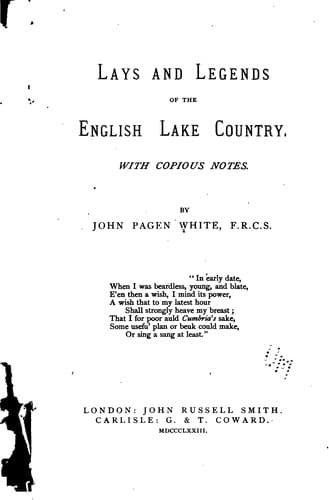
Lays and Legends of the English Lake Country: With Copious NotesWhite, John Pagen
General
Lays and Legends of the English Lake Country: With Copious Notes
White, John Pagen
Lake District (England) -- Poetry; Legends -- England -- Lake District
from morning _ad nonam_, which was three o'clock, as from six to
three.
Egremont was probably a place of strength, and the seat of some
powerful chief, during the Heptarchy, and in the time of the
Danes. The ruins of the Castle, on the west of the town, stand on
an eminence, the northern extremity of which forms a lofty mound,
seventy-eight feet in perpendicular height above the ditch which
surrounds the fortress. On the crown of this hill, it is believed,
there formerly stood a Danish fortification. The mound is said to
be artificial. Tradition goes so far as to assert that it is formed
of soil brought by St. Bega from Ireland, as ballast for her ship.
The miraculous power of the Saint must have been largely exercised
to increase it to its present proportions. It still, however,
retains the virtue given to Irish earth by the blessing of St.
Patrick, and no reptile can live upon it.
This fortress is not of very great extent, but bears singular marks
of antiquity and strength. The approach and grand entrance from
the south, has been kept by a draw-bridge over a deep moat. The
entrance to the castle is by a gateway vaulted with semi-circular
arches, and guarded by a strong tower. The architecture of this
tower, which is the chief part of the fortress now standing, points
out its antiquity to be at least coeval with the entry of the
Normans. The outward wall has enclosed a considerable area of a
square form; but it is now gone so much to decay, that no probable
conjecture can be made as to the particular manner in which it
was fortified. On the side next the town a postern remains. To
the westward, from the area, there is an ascent to three narrow
gates, standing close together, and on a straight line, which have
communicated with the outworks: these are apparently of more modern
architecture, and have each been defended with a portcullis. Beyond
these gates is the lofty mount, which has already been referred to,
and on which anciently stood a circular tower, the western side
of which endured the rage of time till within the last century.
The whole fortification is surrounded by a moat, more properly
so called than a ditch, as it appears to have been walled on both
sides. This is strengthened with an outward rampart of earth, which
is five hundred paces in circumference. A small brook runs on the
eastern side of the Castle, and it may be presumed, anciently
filled the moat. The mode of building which appears in part of
the walls, is rather uncommon, the construction being of large
thin stones, placed in an inclined position, the courses lying in
different directions, so as to form a kind of feathered work, the
whole run together with lime and pebbles, impenetrably strong. It
seems to have been copied from the filling parts of the Roman wall.
Public-domain text, read in full here on John Shaqi.
Reviews
Reviews
No reviews yet
Be the first to share your thoughts on this work.
Elsewhere in the archive