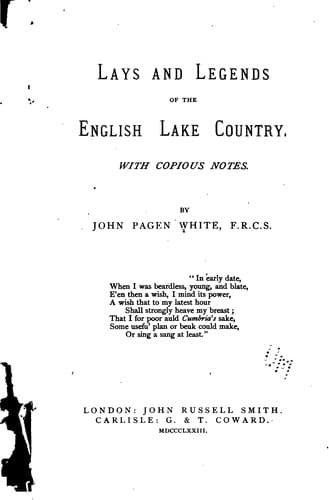
Lays and Legends of the English Lake Country: With Copious NotesWhite, John Pagen
General
Lays and Legends of the English Lake Country: With Copious Notes
White, John Pagen
Lake District (England) -- Poetry; Legends -- England -- Lake District
After the conquest of England by the Normans, the counties of
Cumberland and Westmorland, the ancient inheritance of the Scottish
Kings, as well as the county of Northumberland, were placed by William
under the English crown. But the regions thus alienated were not
allowed to remain in the undisturbed possession of the strangers. For
a long period they were disquieted by the attempts which from time to
time were made by successive kings of Scotland to re-establish their
supremacy over them. Supporting their pretensions by force of arms,
they carried war into the disputed territory, and conducted it with a
rancour and cruelty which spared neither age or sex. The two nations
maintained their cause, just or unjust, with unfaltering resolution;
or if they seemed to hesitate for a moment, and a period of settlement
to be at hand, their frequent compromises only ended in a renewal of
their differences. Thus these northern counties continued to pass
alternately under the rule of both the contending nations, until the
Scottish dominion over them was finally terminated by agreement in the
year 1237; Alexander of Scotland accepting in lieu lands of a certain
yearly value, to be holden of the King of England by the annual render
of a falcon to the Constable of the Castle of Carlisle, on the Festival
of the Assumption.
The resumption, at no distant period, of the manors which had been
granted to Alexander, renewed in all their strength the feelings of
animosity with which the Scots had been accustomed to regard their
southern neighbours, and the feuds between the two kingdoms continued
with unabated violence for more than three centuries longer. The
dwellers in the unsettled districts lying along the English and
Scottish borders, being originally derived from the same Celtic stock,
had been gradually and progressively influenced as a race by the
admixture of Saxon and Danish blood into the population; and although
much of the Celtic character was thereby lost, they seem to have
retained in their mountains and forests much of the spirit, and many
of the laws and manners, of the ancient Britons. They continued to
form themselves into various septs, or clans, according to the Celtic
custom; sometimes banded together for the attainment of a common
end; and as often at feud, one clan with another, when some act of
personal wrong had to be revenged upon a neighbouring community. Thus
a state of continual restlessness, springing out of mutual hatred and
jealousies, existed among the borderers of either nation. The same
feelings of enmity were fostered, and the same system of petty warfare
was carried on, between the borderers of the two kingdoms. Cumberland
and Westmorland, from their position, were subject to the frequent
inroads of the Scots; by whom great outrages were committed upon the
inhabitants. They drove their cattle, burned their dwellings, plundered
their monasteries, and even destroyed whole towns and villages. A
Public-domain text, read in full here on John Shaqi.
Reviews
Reviews
No reviews yet
Be the first to share your thoughts on this work.
Join the Discussion
Join the discussion
Sign in to leave a comment or review.
Sign InorCreate an account