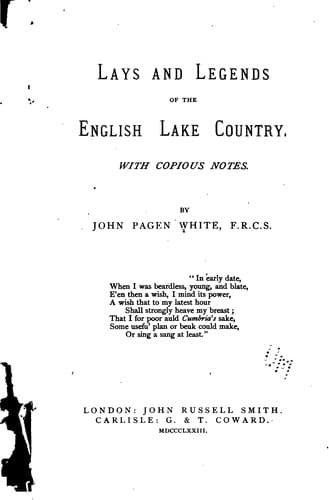
Lays and Legends of the English Lake Country: With Copious NotesWhite, John Pagen
General
Lays and Legends of the English Lake Country: With Copious Notes
White, John Pagen
Lake District (England) -- Poetry; Legends -- England -- Lake District
"In the deep solitude of the woods betwixt Bolton and Barden, the
Wharf suddenly contracts itself to a rocky channel little more
than four feet wide, and pours through the tremendous fissure with
a rapidity proportionate to its confinement. This place was then,
as it is yet, called the Strid, from a feat often exercised by
persons of more agility than prudence, who stride from brink to
brink, regardless of the destruction which awaits a faltering step.
Such, according to tradition, was the fate of young Romillé, who
inconsiderately bounding over the chasm with a greyhound in his
leash, the animal hung back, and drew his unfortunate master into
the torrent. The forester, who accompanied Romillé, and beheld
his fate, returned to the Lady Aäliza, and, with despair in his
countenance, enquired, 'What is good for a bootless Bene?' To which
the mother, apprehending that some great calamity had befallen her
son, instantly replied, 'Endless Sorrow.'
"The language of this question, almost unintelligible at present,
proves the antiquity of the story, which nearly amounts to proving
its truth. But 'bootless Bene' is unavailing prayer; and the
meaning, though imperfectly expressed, seems to have been, 'What
remains when prayer is useless?'"
The accuracy of this account, though admitted to be true so far as
the death of a scion of Romili's house, is however doubted by Dr.
Whitaker, who states that the son of the Lady Alice or Aäliza was a
party and witness to the charter of translation to Bolton in 1154
of the Canons of the Priory of Embsay, founded in 1121 by William
de Meschines and Cecilia de Romili his wife. Besides, as the Boy
of Egremond was alive in 1160, and a partaker in the rebellion of
the Pictish Celts of Scotland, of which the object was to set him
on the throne as the rightful heir, Dr. Whitaker is of opinion that
the story refers to one of the sons (both of whom died young) of
Cecilia le Meschines, grandmother of Lady Alice.
Public-domain text, read in full here on John Shaqi.
Reviews
Reviews
No reviews yet
Be the first to share your thoughts on this work.
Elsewhere in the archive
Join the Discussion
Join the discussion
Sign in to leave a comment or review.
Sign InorCreate an account