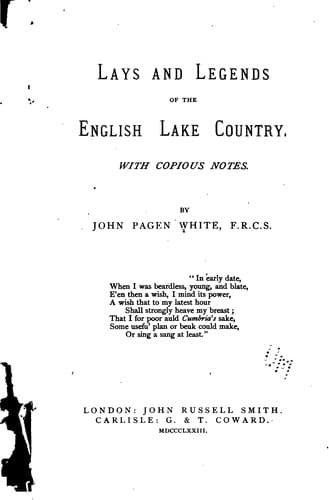
Lays and Legends of the English Lake Country: With Copious NotesWhite, John Pagen
General
Lays and Legends of the English Lake Country: With Copious Notes
White, John Pagen
Lake District (England) -- Poetry; Legends -- England -- Lake District
There is however an oversight of some importance in Whitaker's
statement. He altogether omits the second generation of the
descendants of William le Meschines. Alice, the daughter of W. le
Meschines, married Robert de Romili; Alice, her daughter, married
Fitz-Duncan, who assumed the name of his wife, and was William le
Romili. If their son was "the Boy of Egremond," he could not have
been a witness to the charter of translation in 1154. If he was
drowned in the Wharf, his death could not have been the occasion of
the refounding of the Priory at Bolton. If the son of Cecilia le
Meschines was "the Boy of Egremond"; as he might be so styled from
his father's barony; he may have been drowned at the Strid, but
his mother could not have been the second foundress of the Priory;
for, as Whitaker says, the founders of Embsay were already dead.
Tradition, moreover, clings to the name of the Lady Alice, as being
that of the pious dispenser of her goods to sacred and religious
uses. And however history may conflict with tradition, there will
remain, that the Lady of Skipton, Cockermouth, and the Allerdales,
bestowed her lands and goods most liberally upon the Abbeys of
Fountains and Pomfret, and other religious confraternities;
that she, the Lady Alice, seems always to have cherished those
dispositions whose spiritual convictions moved in unison with
the votive religious practices of the age; and although she, for
the health of her dear son's soul (if he it were who perished in
the Wharf) could not have founded near the scene of his untimely
fate, the Priory before mentioned; its legendary history, which
has so enshrined her affections and her sorrows, will continue to
connect in the future, as in the past, the image of the youthful
Romili with her griefs, and the stately Priory of Bolton with his
imperishable name.
FOOTNOTES:
[22] The scalp with the hair attached.
[23] In the early and middle ages kissing was the common form of
salutation, and the _osculum pacis_ was a sign of reconciliation and
charity. Examples will occur to every reader of Scripture and the
classics.
[24] Dr. Whitaker. Vide notes to the "Bridals of Dacre," for instances.
SÖLVAR-HOW.
Up the valley of Brathay rode Dagmar the Dane.
There was gold on her bit, there was silk on her rein.
You might see her white steed in the distance afar,
On the green-breasted hill, shining out like a star;
Where beyond her on high in his barrow lay sleeping
Old Sölvar the chief; and the shade, that sat keeping
His fame, by his tomb sang the Norseland's wild strain.
Public-domain text, read in full here on John Shaqi.
Reviews
Reviews
No reviews yet
Be the first to share your thoughts on this work.
Elsewhere in the archive
Join the Discussion
Join the discussion
Sign in to leave a comment or review.
Sign InorCreate an account