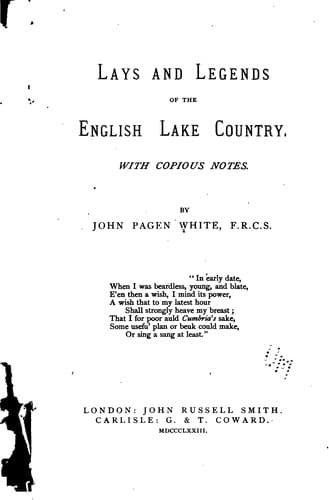
Lays and Legends of the English Lake Country: With Copious NotesWhite, John Pagen
General
Lays and Legends of the English Lake Country: With Copious Notes
White, John Pagen
Lake District (England) -- Poetry; Legends -- England -- Lake District
While many Celtic names of places remain to attest the prolonged
sovereignty of the Britons in Cumbria, by far the greater number
refer to a period when the enterprising Northmen, coming from
various shores, but all included under the comprehensive title
of Danes, had pushed their conquests into the mountain country
of Cumberland and Westmorland and those portions of the north of
Lancashire, which are comprised within the district of the English
Lakes. This territory had become the exclusive possession of the
Norwegian settlers. Every height and how, every lake and tarn,
every swamp and fountain, every ravine and ghyll, every important
habitation on the mountain side, the dwelling place amidst the
cleared land in the forest, the narrow dell, the open valley,
every one is associated with some fine old name that belonged to
our Scandinavian forefathers. Silver How is the hill of Sölvar,
and Butter-lip-how, the mound of Buthar, surnamed Lepr the Nimble;
Windermere and Buttermere, and Elter-water are the meres and water
called after the ancient Norsemen, Windar, and Buthar or Butar,
and Eldir, Gunnerskeld, and Ironkeld, and Butter-eld-keld, are
the spring or marsh of Gunnar, and Hiarn, and Buthar the Old, or
Elder. Bekangs-Ghyll, and Staingill, and Thortillgill, indicate the
ravines or fissures, which were probably at one time the boundaries
respectively of the lands of Bekan, and Steini, and Thortil;
Seatallau and Seatoller were once the dwelling places whence Elli
and Oller looked on the plains below them; and in Ormthwaile, and
Branthwaite, and Gillerthwaite we recognise the lands cleared amid
the forests with the axe, whose several possessors were Ormr, and
Biorn, and Geller; while Borrodale, and Ennerdale, and Riggindale,
and Bordale recall the days when these remote valleys were subject
to the lordly strangers Borrhy, and Einar, and Regin, and Bor. All
these names are Scandinavian proper names, and are to be found in
the language of that ancient race, of whose sojourn amongst our
hills so many traces remain in the nomenclature of the district.
Public-domain text, read in full here on John Shaqi.
Reviews
Reviews
No reviews yet
Be the first to share your thoughts on this work.
Elsewhere in the archive
Join the Discussion
Join the discussion
Sign in to leave a comment or review.
Sign InorCreate an account