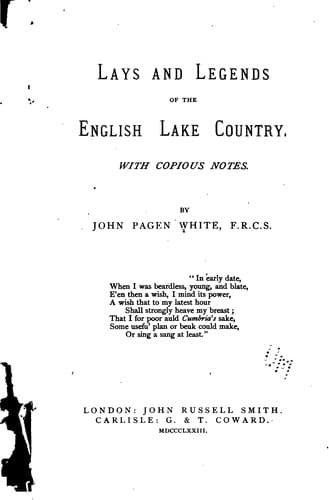
Lays and Legends of the English Lake Country: With Copious NotesWhite, John Pagen
General
Lays and Legends of the English Lake Country: With Copious Notes
White, John Pagen
Lake District (England) -- Poetry; Legends -- England -- Lake District
Coming from the wildest and poorest part of the Norwegian coast,
and mixing with the Celtic tribes of these regions, in the early
ages; those hardy sons of the sea made extensive and permanent
settlements among them. They penetrated into the remotest recesses
of the mountains, carrying thither their wild belief in the old
northern gods, and their rude ideas of a future life. Their warlike
recollections, and their attachment to the scenes of their valorous
exploits, fostered the notion which was not uncommon among them,
that the spirits of chieftains could sometimes leave the halls
of Valhalla, and, seated each on his own sepulchral hill, could
look around him on the peaceful land over which in life he had
held rule, or on that beloved sea which had borne him so often to
war and conquest. It was this thought that induced them to select
for their burial places high mountains, or elevated spots in the
valleys and plains. As a natural result of their long continued
dominion in the North of England, they came to be classed in the
imagination of the people with invisible and mystic beings which
haunted that district. The shadows of the remote old hills were
the abodes of enchantment and superstition. And the spirits of the
departed were supposed to be seen visiting the earth, sometimes in
the guise of a Celtic warrior careering on the wind, and sometimes
in the form of one of the old northern chieftains sitting solitary
upon his barrow. It is related of one being permitted to do so for
the purpose of comforting his disconsolate widow, and telling her
how much her sorrow disquieted him. Hence also the dwellers among
the hills, it is said, still fancy they hear on the evening breeze
musical tones as of harp strings played upon, and melancholy lays
in a foreign tongue; a beautiful concert, to which we owe the
exquisite medieval legend of the cattle, in thraldom to the potent
spirit of harmony that rings through the air, often when no musical
sound is audible to the organ of man, pricking up their ears in
astonishment, as they listen to the Danish or Norseland Boy, sadly
singing the old bardic lays over the barrows of his once mighty
forefathers.
Public-domain text, read in full here on John Shaqi.
Reviews
Reviews
No reviews yet
Be the first to share your thoughts on this work.
Elsewhere in the archive
Join the Discussion
Join the discussion
Sign in to leave a comment or review.
Sign InorCreate an account